

What happens to my corporation when I die in Canada?
Two questions sit behind this search: what happens to the company, and what will my family actually keep after tax. The second one is arithmetic, and it is worth doing carefully.
This guide walks the sequence in plain language: what happens to the corporation itself, how the deemed disposition of your shares works, why a second layer of tax can arise when corporate value is distributed, and which routes exist to address the overlap. It then hands you a calculator so you can run the numbers on your own facts.
Nothing here is tax or legal advice. Goald & Co Financial Inc. is an advanced corporate financial and insurance planning firm; we work alongside your CPA and legal counsel rather than replacing them. Every figure below is rounded, illustrative and editable.
Interactive tool
Business Owner Estate Tax Calculator
Estimate deemed-disposition tax, corporate-level tax, extraction tax and the amount that may ultimately reach your family. No email required, results shown immediately.
Open the estate tax calculator- Your corporation does not disappear
- Step 1: deemed disposition of the shares
- What adjusted cost base means
- Spousal rollover: deferral, not elimination
- QSBC shares and the LCGE
- Step 2: getting the value out
- Why the same value can be taxed twice
- CDA, tax pools, insurance and debt
- Post-mortem routes to review
- Why salary is not the answer
- What the calculator covers
- Planning checklist
- When this may not fit
- FAQ
Reviewed August 2026 by Goald & Co Financial Inc.
Your corporation does not disappear when you die.
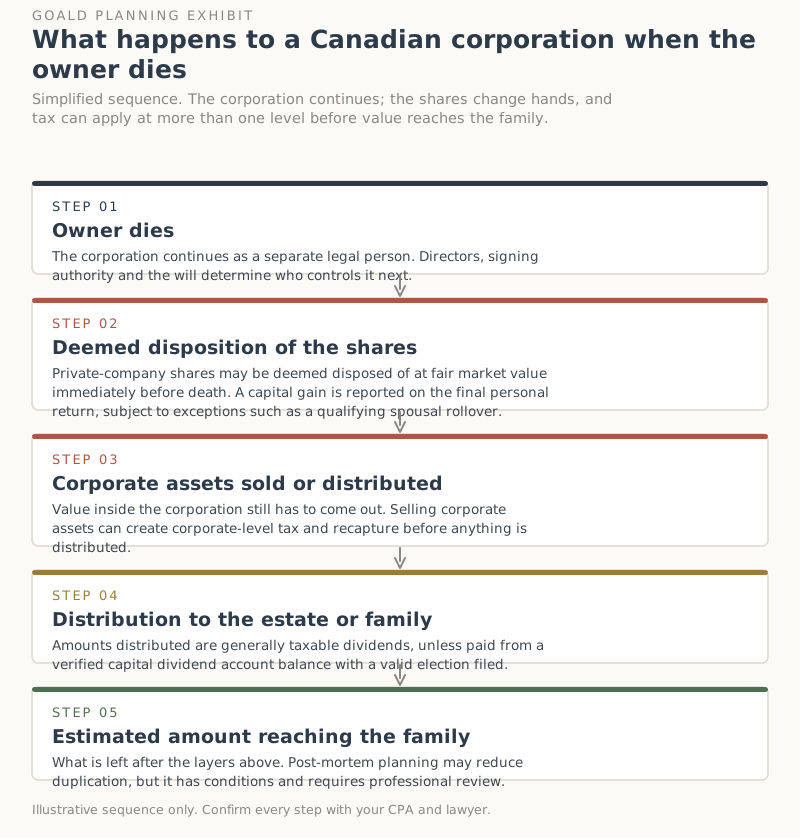
Short answer: the corporation keeps existing. It is a separate legal person, and death does not dissolve it. What changes is who owns the shares, and it is that change of ownership that can trigger tax.
Canada does not have a standalone inheritance tax or estate tax. That is true, and it is also incomplete. Tax can still apply before assets reach beneficiaries, through two separate events: the deemed disposition of capital property on the final personal return, and the tax that applies when corporate value is later taken out of the company.
Practically, someone still has to run the company on the Monday after. Directors, signing authority on the bank account, the shareholders' agreement and the will all matter more in that first month than any tax calculation. Sort out control first; the tax mechanics below follow.
Interactive tool
What would your family actually keep?
The calculator models the deemed disposition, corporate-level tax and extraction tax line by line, with every rate editable. It is a simplified illustration, not a prediction.
Open the estate tax calculatorStep 1: the deemed disposition of your shares.
Short answer: for tax purposes you are generally treated as having sold your shares at fair market value immediately before death, even though nothing was sold.
Private-company shares may be deemed disposed of at fair market value immediately before death, subject to the exceptions in the Income Tax Act such as a qualifying transfer to a spouse, common-law partner or qualifying spousal trust. The resulting capital gain is reported on the deceased's final return, and the tax is payable in cash on the filing deadline. The business itself is usually the least liquid asset the family owns, which is where the pressure comes from.
Under current law the capital gains inclusion rate is one-half. The proposed increase to a two-thirds inclusion rate was cancelled and should not be treated as in force. Because the effective rate on a full gain still depends on province, income and the facts, the calculator uses a visible editable assumption rather than hard-coding a provincial conclusion.
What adjusted cost base means, and why a nominal ACB hurts.
Short answer: adjusted cost base is what the shares cost you for tax purposes. The gain is broadly value minus ACB, so a low ACB produces a large gain.
Most founders subscribed for their shares for a token amount when the company was incorporated. A $100 ACB is common. Twenty years later, if the shares are worth $5,000,000, the modelled gain is about $4,999,900 — almost the entire value of a company you built rather than bought.
ACB can be increased by later share purchases, certain reorganisations and some historical elections. It is worth asking your CPA what your actual ACB is before assuming it is nominal, and worth documenting it now rather than reconstructing it under deadline pressure later.
The spousal rollover: deferral, not elimination.
Short answer: a qualifying transfer to a spouse, common-law partner or qualifying spousal trust generally allows the shares to pass at cost, deferring the gain. The tax is postponed, not cancelled.
On the surviving spouse's later death or disposition, the same accrued value is back on the table, usually larger. Families who read the first death as "no tax" often plan for the wrong event. The realistic planning question is what the exposure looks like at the ultimate transfer to the next generation, which is why the calculator defaults to that scenario.
Whether the rollover applies depends on the will, the residence of the recipient, the type of trust and the elections filed. It is not automatic in every case, and an executor can sometimes elect out of it deliberately where using the deceased's exemption or losses produces a better overall result. That is a CPA decision made with the numbers in front of you.
QSBC shares and the capital gains deduction.
Short answer: where the shares are qualified small business corporation shares, a lifetime capital gains deduction may shelter part of the gain. Qualification is a set of tests, not a status you can assume.
The tests look at what the corporation's assets are used for, over a period before the disposition as well as at the time of disposition, and at who held the shares. A company holding significant passive investments, surplus cash or rental real estate can fail them. That is why purification is a multi-year conversation with a CPA rather than something arranged after a death.
The calculator never assumes any exemption. You enter the amount your CPA expects to be available, and it reduces the modelled gain but never below zero. Confirm the current indexed amount and your eligibility with the CRA page listed in Sources.
Step 2: the corporate assets still have to come out.
Short answer: paying tax on the shares does not put money in the family's hands. The value is still inside the corporation, and getting it out is a second taxable event.
Two things can happen inside the company. Selling corporate assets to raise cash can trigger corporate-level capital gains tax and recapture. Then distributing what remains to the estate or the beneficiaries is generally a taxable dividend, unless it is paid out of a verified capital dividend account balance.
The capital dividend account is a notional tax account rather than a bank balance. A capital dividend requires a verified balance and a valid s.83(2) election filed before the dividend becomes payable. For a corporate-owned policy, the credit is generally the qualifying proceeds less the policy's adjusted cost basis. Repaying policy borrowing changes the cash available; it does not by itself change that formula.
A wind-up or a share redemption is a structured version of the same thing, with its own mechanics and its own tax pools. The point for planning is simply that the second layer exists and has to be modelled alongside the first.
Why the same value can be taxed twice.
Short answer: the terminal return taxes the increase in the value of your shares, and the distribution taxes the same underlying corporate value again as it leaves the company. Without planning, the two can overlap.
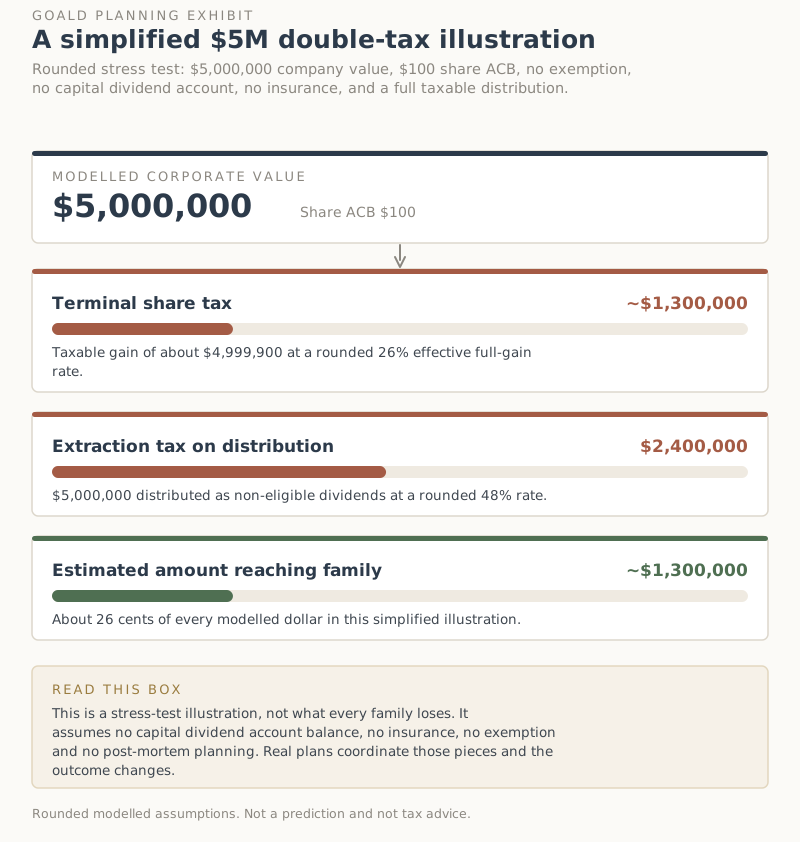
Work the arithmetic slowly, because the surprise should come from the calculation rather than from a headline. Take a company worth $5,000,000 immediately before death, shares with a $100 adjusted cost base, no exemption available, no capital dividend account balance, no insurance and no post-mortem planning.
| Line | Rounded assumption | Illustrative amount |
|---|---|---|
| Company value immediately before death | Fair market value, after corporate debt | $5,000,000 |
| Adjusted cost base of the shares | Nominal founder subscription | $100 |
| Modelled share gain | Value less ACB | $4,999,900 |
| Terminal share tax | 26% effective rate on the full gain | ~$1,300,000 |
| Distribution to the family | Full amount as non-eligible dividends | $5,000,000 |
| Extraction tax | 48% non-eligible dividend rate | $2,400,000 |
| Estimated amount reaching the family | Value less both layers | ~$1,300,000 |
| Estimated leakage | Total tax over gross modelled value | ~74% |
Simplified, rounded and illustrative. The rates are editable assumptions, not province-specific legal conclusions, and this scenario assumes a completely uncoordinated distribution.
This is a stress-test illustration, not what every family loses. It deliberately switches off every mitigating feature: no exemption, no capital dividend account, no insurance, no eligible-dividend capacity and no post-mortem planning. Its purpose is to show why the overlap is worth reviewing, not to predict a result. Families who plan with their CPA and lawyer generally land somewhere very different.
Interactive tool
Run the same arithmetic on your own numbers
Change the company value, the share ACB, the exemption, the capital dividend account, the insurance and every rate. The tool shows each line so you can see exactly where the money goes.
Open the estate tax calculatorHow the CDA, tax pools, insurance and debt change the picture.
Short answer: the second layer is where most of the improvement lives, because the first layer is largely a function of value and cost base.
| Feature | What it can change | What it cannot do |
|---|---|---|
| Existing CDA balance | Allows part of a distribution to be paid as a capital dividend where a valid balance exists and the election is filed | It is notional, not cash, and an excessive election carries penalty tax |
| Corporate life insurance | Provides cash when the tax is due, and the amount above the policy's adjusted cost basis generally credits the CDA | It does not eliminate the terminal share tax, and premiums are generally not deductible |
| Policy adjusted cost basis | Reduces the insurance credit to the CDA as it grows and then declines over the life of the contract | It is a policy figure to confirm with the insurer, not an assumption |
| GRIP / eligible-dividend capacity | May allow part of a taxable distribution to be paid at the lower eligible-dividend rate | Capacity is limited and calculated by your CPA |
| RDTOH | May generate a refund to the corporation when taxable dividends are paid | It does not make a distribution tax-free to the recipient |
| Corporate debt and shareholder loans | Change both the value of the shares and the cash actually distributable | They rarely change the character of what is left |
Directional only. Each item is calculated by your CPA against the corporation's actual filings.
Read the mechanics in detail in the capital dividend account guide and corporate-owned life insurance in Canada.
Post-mortem routes to review.
Short answer: the tax system contains routes designed to address the duplication. They work, but they are conditional, deadline-driven and fact-specific, so none of them should be treated as a guaranteed saving.
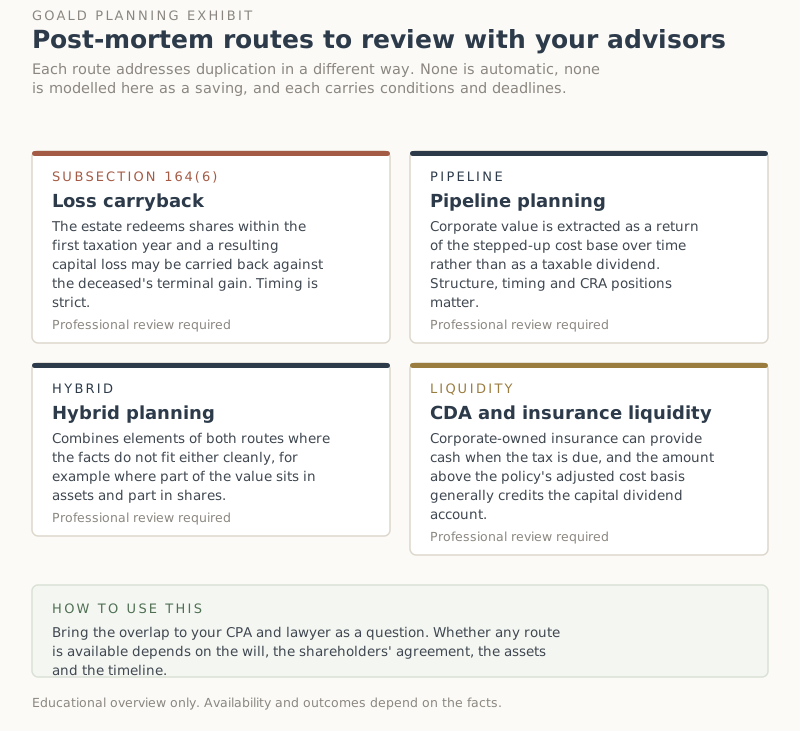
- Subsection 164(6) loss carryback. Where the estate redeems shares within the first taxation year and a capital loss results, the loss may be carried back against the deceased's terminal gain. The timing rules are strict and the loss has to actually arise.
- Pipeline planning. Corporate value is extracted over time against the stepped-up cost base of the shares rather than as a taxable dividend. It depends on structure, timing and CRA's administrative positions.
- Hybrid planning. Combines features of both where the assets and shares do not fit either route cleanly.
- Wind-up or share redemption. Sometimes the simplest route, sometimes the most expensive one. It depends on the tax pools available.
The technical detail for advisors is in the post-mortem planning technical guide. The calculator deliberately assigns no savings to any of these routes.
Why salary is not the post-death extraction method.
Short answer: the salary-versus-dividend question belongs to a living owner drawing compensation. It is not the choice an estate faces.
Salary is deductible to a corporation because it is payment for work performed. A deceased shareholder is not performing work. Paying salary to a surviving family member is only defensible where that person genuinely works in the business and the amount is reasonable for the role, with the usual payroll obligations and documentation. Treating salary as a general route to move a deceased owner's corporate value to the family is not a plan; it is an audit exposure.
The realistic routes are dividends, redemptions, a capital dividend where a valid balance and election exist, a wind-up, and the post-mortem structures above. Those are what the calculator models. For living-owner compensation, see salary versus dividends in Canada.
What the calculator includes and excludes.
The tool is deliberately narrow so the arithmetic stays inspectable.
| Included | Excluded |
|---|---|
| Deemed disposition of the shares, with an editable effective full-gain rate | Probate, estate administration and executor costs |
| An LCGE amount you enter, never assumed | Provincial variations and multiple share classes |
| A qualifying spousal rollover shown as deferral | Trusts, holding-company chains and freeze structures |
| Corporate tax on embedded gains and other liquidation tax you enter | RRSP, RRIF, TFSA and personally held property |
| Existing CDA, insurance CDA and capital-gain CDA credits | US or other foreign exposure |
| GRIP capacity and separate eligible and non-eligible dividend rates | Any credit for post-mortem planning |
| Insurance proceeds net of included cash value and repaid borrowing | Salary as an extraction route, which is not applicable |
Interactive tool
See every line of the calculation
The calculator shows each intermediate figure, warns about double counting, and states the capital dividend account separately so nothing is hidden inside a single number.
Open the estate tax calculatorA planning checklist for you and your CPA.
- Confirm the share ACB. Ask your CPA for the actual figure and where it is documented.
- Get a defensible valuation approach. Fair market value drives the entire calculation.
- Test QSBC status. Review asset composition well before any sale or transition.
- Read the will against the corporation. Check that the intended rollover or transfer actually works.
- Verify the CDA balance. Ask for the running account, not an estimate.
- Quantify the liquidity gap. Decide where the cash to pay the tax comes from.
- Review the shareholders' agreement. Confirm it is funded and consistent with the will.
- Model the ultimate transfer, not only the first death. A spousal rollover moves the event, not the exposure.
- Ask about post-mortem routes now. Some depend on structure decisions made years earlier.
- Review annually. Value, tax pools, law and family circumstances all move.
See the anonymized planning examples in the real estate estate freeze case study and the corporate investment and estate planning case study, and the structural options in estate freezes and succession planning.
When this may not fit.
Every idea on this page has conditions attached. These are the common situations where the answer is "not yet", "not here", or "not at all".
- You are not incorporated. Personally held property follows different rules on death.
- The corporation has little accrued value, in which case the deemed disposition is a small event.
- Your shares are already held through a freeze or a trust structure, which changes who bears the growth.
- A sale is already under negotiation, in which case the sale plan drives the tax analysis first.
- Residency or a foreign estate is involved, which brings a separate set of rules entirely.
- The estate is already in administration, where the executor and their advisors are working to fixed deadlines.
Frequently asked questions.
The corporation continues to exist as a separate legal person. Your shares in it form part of your estate and are dealt with under your will. For tax purposes you are generally treated as having disposed of those shares at fair market value immediately before death, subject to exceptions such as a qualifying spousal rollover, so a capital gain may be reported on the final personal return.
Canada does not have a standalone inheritance tax or estate tax. Tax can still arise before assets reach beneficiaries, mainly through the deemed disposition of capital property on the final return and through the tax that applies when corporate value is later distributed to shareholders.
They may be. Private-company shares are capital property and may be deemed disposed of at fair market value immediately before death, subject to applicable exceptions. The resulting capital gain is reported on the deceased's final return, and the tax is payable even though nothing was actually sold.
A qualifying transfer to a spouse, common-law partner or qualifying spousal trust generally allows the shares to pass at cost, which defers the gain rather than eliminating it. The accrued value is taxed on the survivor's later death or disposition, so the exposure moves rather than disappears.
Yes, shares can pass to children under a will. The spousal rollover does not apply, so the deemed disposition is generally taxable on the final return, and the value inside the company still has to be distributed at some point. This is the ultimate transfer scenario the calculator models by default.
The terminal return taxes the accrued gain on your shares, and a later distribution of the same underlying corporate value is generally taxable again in the recipient's hands as a dividend. Without planning, the two layers can overlap. Post-mortem routes such as a subsection 164(6) loss carryback, pipeline planning or hybrid planning exist to address the duplication, subject to conditions.
Adjusted cost base is what the shares cost you for tax purposes, adjusted for certain later events. The capital gain is broadly fair market value less adjusted cost base. Founders who subscribed for shares for a nominal amount often have a very low ACB, so almost the entire value of the company shows up as a gain.
Corporate-owned life insurance can provide cash inside the company when the tax is due, and the amount of the proceeds above the policy's adjusted cost basis generally credits the capital dividend account. A capital dividend still requires a verified balance and a valid election. Insurance does not eliminate the terminal tax on the shares; it changes where the liquidity comes from.
Pipeline planning is a post-mortem structure in which the corporate value is extracted over time against the stepped-up cost base of the shares rather than as a taxable dividend. It depends on structure, timing and CRA's administrative positions, and it is implemented by the estate's tax and legal advisors rather than assumed.
Footnote
This publication is protected by copyright. Goald & Co Financial Inc. is not engaged in rendering tax or legal advice. This guide contains a general discussion of certain tax and legal developments and should not be construed as tax or legal advice. Should you wish to discuss this or any other Goald & Co guide, please contact info@goald.ca.
Where to go deeper.
These pages carry the technical detail behind the decisions on this page.
Bring the number to your CPA with the work shown.
We model the estate exposure alongside your accountant and lawyer, quantify the liquidity gap, and set out the options in writing. No product conversation until the arithmetic is agreed.
Review your corporate tax strategyPrimary sources cited in this guide
Each link points to the official CRA publication or statutory provision supporting a factual statement in this guide. Analysis, sequencing and illustrative figures are Goald & Co's own.
- CRA — Capital gains and the deemed disposition of capital property on death
- CRA — Retirement or death of a business owner
- CRA — Net capital losses of a deceased taxpayer (including the subsection 164(6) carryback by the estate)
- CRA Income Tax Folio S3-F2-C1 — Capital Dividends (the capital dividend account and the s.83(2) election)
- CRA — Line 25400, Capital gains deduction (qualified small business corporation shares)
- CPABC — Tax implications and planning opportunities on the death of a taxpayer (double tax and post-mortem planning overview)
- CRA — What's new for corporations (confirming the proposed two-thirds capital gains inclusion rate increase was cancelled)
Disclaimer. This guide is general educational information published by Goald & Co Financial Inc., an advanced corporate financial and insurance planning firm. It is not tax, legal or accounting advice, and no client relationship is created by reading it. Goald & Co does not prepare tax returns or financial statements; we work alongside your CPA and legal counsel. Outcomes vary by province, income type, corporation type, shareholder facts and changes in law. Verify every figure and every structural step with your own advisors before acting.