A planning problem, not a product problem.
The question is not whether death triggers tax. It is how much, when, and where the cash comes from.
This page walks through Synthetic Case A — Multi-Entity Real Estate Family, a fictional composite planning analysis for a Canadian family holding real estate and an operating business through three corporations. Every figure was independently generated for education. Nothing here is a client record, an achieved result, or advice for your own structure.
It is published because the sequence is transferable even when the numbers are invented. Families with concentrated, leveraged, illiquid wealth face the same three questions in the same order: how big is the exposure, how does it stop growing, and where does the cash come from on the day it is needed.
Goald & Co is an advanced corporate financial and insurance planning firm. We model, size and coordinate. Your CPA and legal counsel implement.
The planning model in one page.
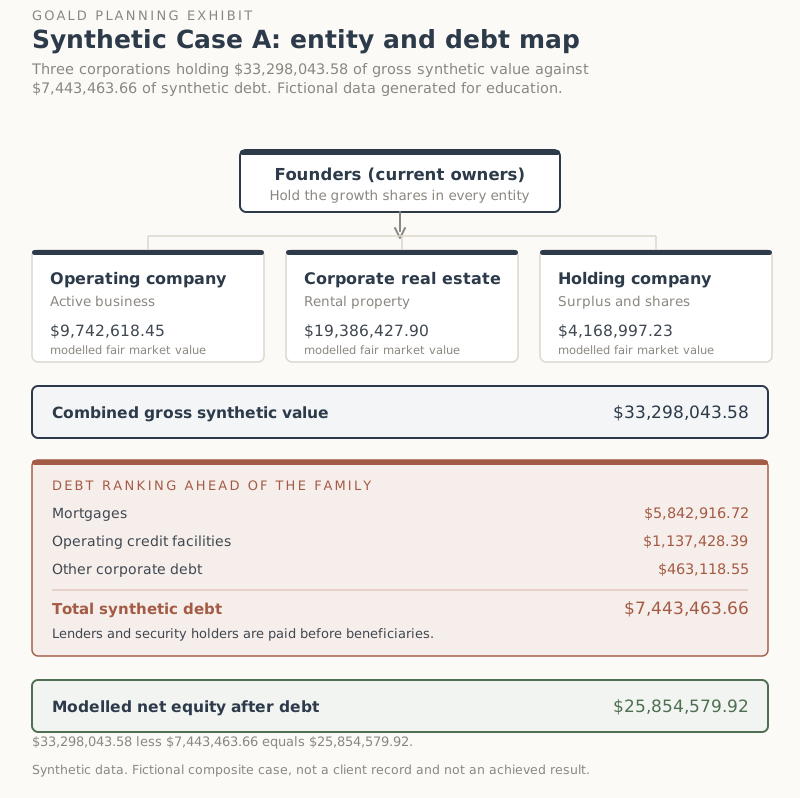
Synthetic Case A — Multi-Entity Real Estate Family is a fictional multi-entity family group holding $33,298,043.58 of combined synthetic operating, real-estate and holding-company value against $7,443,463.66 of synthetic debt, leaving $25,854,579.92 of modelled net equity. Every value on this page was independently generated for education.
The modelled conclusion, in order of sequence:
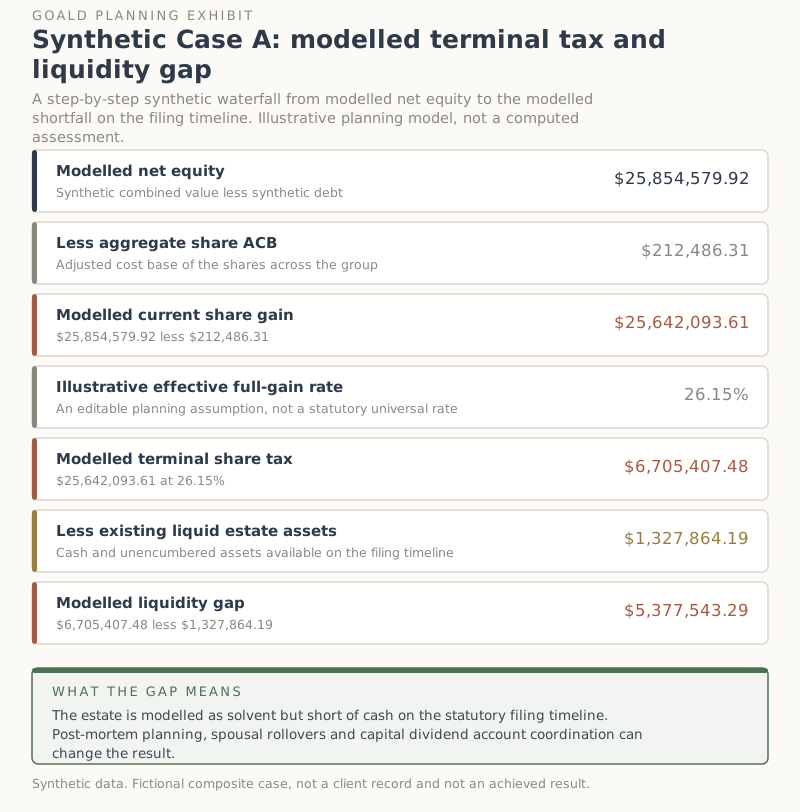
- Size the exposure. Modelled net equity of $25,854,579.92 less an aggregate share adjusted cost base of $212,486.31 gives a modelled current share gain of $25,642,093.61. At an illustrative effective full-gain rate of 26.15%, an editable planning assumption rather than a statutory universal rate, the modelled terminal share tax is $6,705,407.48. Against $1,327,864.19 of existing liquid estate assets, the modelled liquidity gap is $5,377,543.29.
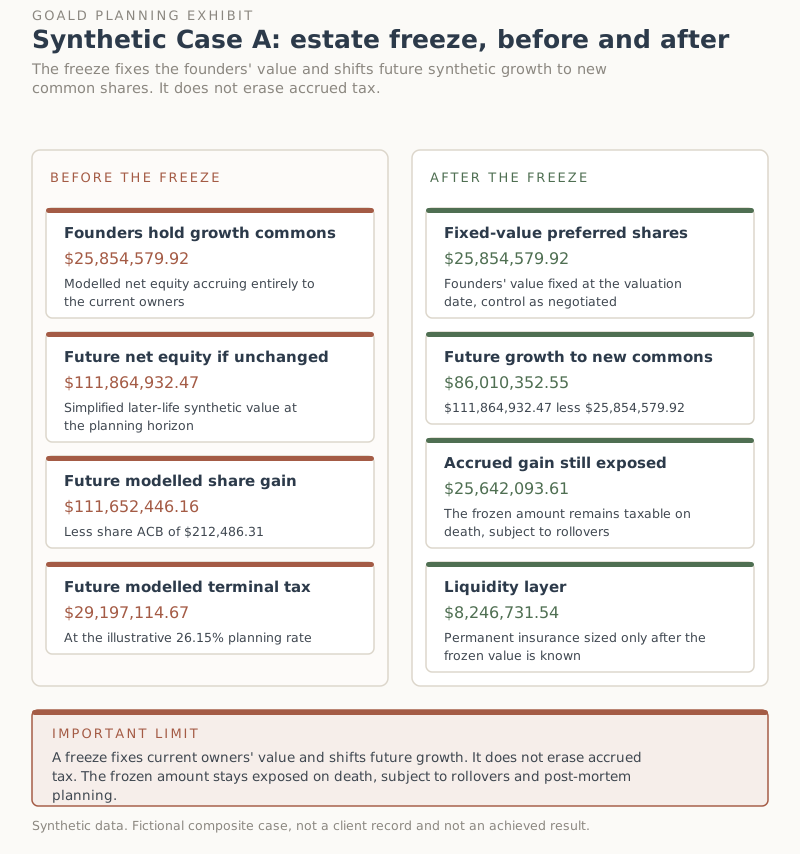
- Stop the target moving. On a simplified later-life view where future growth keeps accruing to the current owners, modelled net equity of $111,864,932.47 would produce a modelled gain of $111,652,446.16 and modelled terminal tax of $29,197,114.67. An estate freeze fixes the founders' value at $25,854,579.92 and shifts $86,010,352.55 of modelled future growth to new common shares. A freeze does not erase accrued tax.
- Fund the known amount. A synthetic corporate policy death benefit of $8,246,731.54 is modelled only after the frozen value is known, and only where premium capacity and insurability support it.
- Document the route out. With a policy adjusted cost basis of $1,083,642.77, the potential capital dividend account credit is modelled at $7,163,088.77. The capital dividend account is a notional tax account: a valid election and a verified balance are required.
The objective is not a smaller tax bill in isolation. It is a tax bill the family can pay without a forced sale.
Objectives built into the model.
Synthetic Case A — Multi-Entity Real Estate Family models a fictional group combining an active operating business with corporate real estate held through separate entities. The founders are modelled as still active in the business, still reinvesting, and still holding every growth share.
Four objectives are set for the synthetic case and used as the test for every later recommendation.
- Preserve the assets. The property and the business were built to be held, not liquidated on someone else's timetable.
- Avoid a forced sale. The estate should be able to settle its obligations from liquidity rather than from a disposal into whatever market exists at the time.
- Create fairness and liquidity for the next generation. Children inside and outside the business should be treated equitably, which usually requires cash, not just shares.
- Retain appropriate control. Any reorganisation had to leave the founders with the control features they were comfortable with while they remain active.
The synthetic planning snapshot.
Every line below is a synthetic planning input generated for this example. None of it is a statement of any client's balances.
| Planning input | Synthetic figure | Planning note |
|---|---|---|
| Operating company fair market value | $9,742,618.45 | Active business, held by the founders |
| Corporate real estate fair market value | $19,386,427.90 | Rental property held in a separate corporation |
| Holding / investment company fair market value | $4,168,997.23 | Surplus and share holdings |
| Gross value | $33,298,043.58 | $9,742,618.45 + $19,386,427.90 + $4,168,997.23 |
| Mortgages | $5,842,916.72 | Secured against the corporate real estate |
| Operating credit facilities | $1,137,428.39 | Drawn operating lines |
| Other corporate debt | $463,118.55 | Remaining corporate borrowing |
| Total debt | $7,443,463.66 | Ranks ahead of beneficiaries |
| Modelled net equity | $25,854,579.92 | $33,298,043.58 less $7,443,463.66 |
| Aggregate share adjusted cost base | $212,486.31 | Across the three entities |
| Modelled current share gain | $25,642,093.61 | $25,854,579.92 less $212,486.31 |
| Illustrative effective full-gain rate | 26.15% | Editable planning assumption, not a statutory universal rate |
| Modelled current terminal share tax | $6,705,407.48 | $25,642,093.61 × 26.15% |
| Existing liquid estate assets | $1,327,864.19 | Cash and unencumbered assets available on the filing timeline |
| Modelled liquidity gap | $5,377,543.29 | $6,705,407.48 less $1,327,864.19 |
| Capital gains inclusion rate used | One-half | Current law; the proposed increase was cancelled |
Synthetic planning figures generated for education. Not client balances and not a calculated liability.
What Goald reviewed.
Nothing was modelled until the underlying facts were on the table. The review below was run with the family's CPA and legal counsel before any structure was discussed.
- Ownership chart. Every entity, every share class, who holds what, and which entities are associated or connected.
- Share values, adjusted cost base and tax attributes. Including safe income, refundable balances, existing capital dividend account position and any prior reorganisations.
- Active versus passive assets. Which assets sit where, and whether passive holdings affect qualification tests on a future share sale.
- Debt and security. Facility terms, covenants, guarantees, cross-collateralisation and what a lender expects on a change of control or on death.
- Cash flow. Sustainable corporate surplus after operating needs, tax instalments and planned capital expenditure.
- Wills and shareholder documents. Existing wills, shareholders' agreements, buy-sell provisions and whether any of them reflect the current structure.
- Insurability and premium capacity. Whether the intended insured lives are insurable, on what terms, and what premium the balance sheet can carry through a bad year.
What the family was trying to solve.
Synthetic Case A — Multi-Entity Real Estate Family models a real-estate and operating group held across three corporations. The synthetic group carries $33,298,043.58 of gross value against $7,443,463.66 of debt, leaving $25,854,579.92 of modelled net equity. Both figures were generated for this example and are not any client's balances.
Nothing about the modelled business is broken. The problem is structural, and it has four parts.
- Value kept accruing to the founders. Every year of appreciation increased the amount that would be taxed on the founders' final returns rather than accruing to the next generation.
- The wealth was illiquid. Value sat in property and shares, not in cash the estate could use to pay a tax bill.
- Debt sat ahead of the family. Lenders and security holders are paid before beneficiaries. Any estate plan had to work around, not ignore, the borrowing.
- Succession intentions were verbal. The founders knew who they wanted involved in the business, but no structure carried that intention.
The example therefore begins as a modelling exercise, not a product conversation: quantify the exposure under current structure, then test what a coordinated plan could change and what it could not.
What could happen without a coordinated plan?
Under Canadian rules a taxpayer is generally treated as having disposed of capital property at fair market value immediately before death, subject to available rollovers such as a transfer to a surviving spouse or a qualifying spousal trust. For a family whose value sits in appreciated shares and real estate, that deemed disposition is the single largest planning number on the page.
The waterfall below is the modelled sequence for Synthetic Case A — Multi-Entity Real Estate Family. Each line is a synthetic planning figure, not a calculated liability.
Read top to bottom on mobile, left to right on desktop. Each stage is an illustrated planning step, not a computed assessment.
Illustrated synthetic planning figures only. Post-mortem planning — including spousal rollovers, pipeline planning, subsection 164(6) loss carry-back and capital dividend account coordination — can materially change the final result. The purpose of the waterfall is to size the question, not to state an outcome.
Two points matter more than the numbers. First, the exposure grows with the portfolio: doing nothing is itself a decision to let the taxable amount increase. On a simplified later-life view, modelled net equity of $111,864,932.47 would produce a modelled gain of $111,652,446.16 and modelled terminal tax of $29,197,114.67. Second, the estate's problem is usually timing rather than solvency. The modelled family is not poor. The estate simply would not have cash on the day it is needed.
Why buying insurance alone was not the whole plan.
The obvious response to an estate tax bill is to insure it. On its own, that answer fails three tests the family cared about.
- It insures a moving target. If value continues to accrue to the founders, the liability keeps growing and any policy sized today is sized against yesterday's number.
- It does not answer ownership. A death benefit pays money. It does not decide who controls the business, who receives which asset, or how children inside and outside the business are treated fairly.
- It ignores where the money lands. Which entity owns the policy, which entity is the beneficiary, and how proceeds move to the people who need them are structural questions with real tax consequences.
So the sequence was deliberately inverted. Structure first, so the size of the problem stops moving. Liquidity second, sized against the frozen number. Extraction mechanics third, so the money can reach the estate efficiently.
Before, planning event, after.
An estate freeze is a reorganisation in which current owners exchange growth shares for fixed-value preferred shares, and newly issued common shares are subscribed for by the next generation or by a family trust. Future appreciation accrues to the new common shares.
Three stages. On desktop the arrows run left to right; on a narrow screen the stages stack in the same order.
Founders hold growth common shares
All value and all future appreciation accrue to the founders. On the simplified later-life view, modelled net equity reaches $111,864,932.47 and modelled terminal share tax reaches $29,197,114.67.
Valuation and reorganisation
An independent valuation establishes fair market value at the freeze date, modelled here at $25,854,579.92. Legal counsel and the CPA implement the share exchange and the required elections and agreements.
Frozen preferreds plus new growth shares
Founders hold fixed-value preferred shares of $25,854,579.92 and retain the control features negotiated in the reorganisation. $86,010,352.55 of modelled future growth accrues to new common shares held by a family trust or other new shareholders. Accrued tax is not erased.
Illustrative structure only. The share classes, control features, trust terms and elections used in any freeze are drafted by legal counsel and the CPA on the specific facts.
A freeze does not erase the accrued gain and does not eliminate tax. It fixes the value that will be taxed in the founders' hands at the freeze date and redirects future growth to other shareholders. The frozen amount remains exposed on death, subject to available rollovers and post-mortem planning. Anyone describing a freeze as a way to avoid tax is describing something else.
What the freeze bought the family was a known number. Once the liability stops moving, it can be sized, funded and stress-tested. That is the entire point of doing it before the insurance conversation rather than after.
Four layers, in order.
The coordinated plan modelled for the family had four layers. They are sequential: each one assumes the previous one has been implemented properly.
Corporate cleanup and purification, where relevant
Before any reorganisation, the group's balance sheets are reviewed for assets that do not belong where they sit, intercompany balances that were never documented, and passive assets that can affect qualification tests on a future sale of shares. Purification is a CPA-led exercise with conditions attached; it is not automatic and it is not always appropriate.
Freeze, trust and succession
The valuation, the share exchange, the trust deed and the shareholders' agreement are drafted together. The trust terms decide who can benefit and when; the shareholders' agreement decides what happens on death, disability, dispute or departure. Trust outcomes, including any future allocation of gains to beneficiaries, depend on the deed, the attribution and split-income rules and the facts at the time.
Permanent insurance liquidity
Once the frozen value is known, permanent life insurance can be sized against the modelled liability, with ownership placed after a discussion of which entity needs the cash. Cost, insurability and funding capacity are tested before anything is applied for. Insurance funds a liability; it does not remove one.
Capital dividend account and post-mortem coordination
The CPA and legal counsel decide, in advance and in writing, how proceeds are expected to be received, what the corporation's capital dividend account is expected to reflect, and which post-mortem route the estate would follow. This is the layer most often skipped, and the one that determines whether the first three layers actually deliver cash to the right hands.
How life insurance proceeds reach the family.
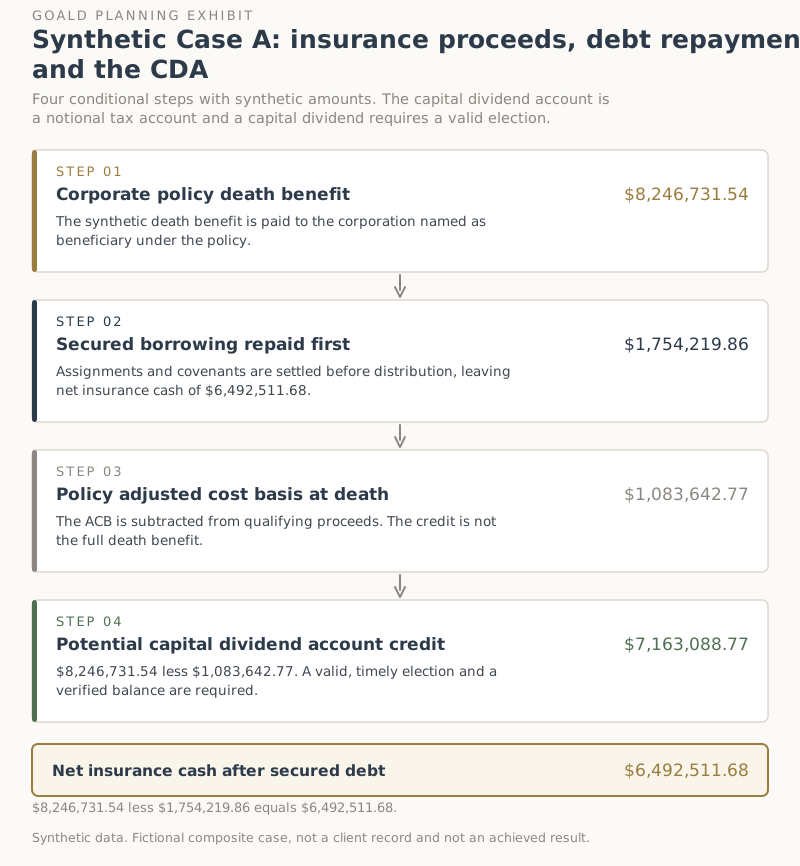
Where a private corporation owns a life insurance policy and is the beneficiary, the proceeds are received by that corporation. The route from there to the family runs through the capital dividend account, and it has conditions at every step.
Each stage depends on the one before it. Skipping a step, or filing the election incorrectly, changes the tax result.
Insurer pays the beneficiary corporation
A synthetic death benefit of $8,246,731.54 is paid to the corporation named as beneficiary under the policy.
Debt or security repaid, if applicable
$1,754,219.86 of secured borrowing is modelled as repaid first, leaving $6,492,511.68 of net insurance cash. Where the policy was assigned as security or where lender covenants apply, those obligations are dealt with before anything is distributed.
Capital dividend account credit
With a policy adjusted cost basis of $1,083,642.77, the potential credit is modelled at $7,163,088.77: qualifying proceeds less the policy's adjusted cost basis. The credit is not automatically equal to the death benefit.
Election, dividend, family
Where a valid balance exists and the election is properly filed before the dividend becomes payable, a capital dividend may be received tax-free by Canadian-resident shareholders, reaching the family or the estate.
See the CRA capital dividends folio in Sources. The capital dividend account is a notional tax account, not a bank account: it can be reduced by other items, a valid election and a verified balance are required, and an excessive or mistimed election carries penalty tax.
Two clarifications worth stating plainly. CRA's capital dividends folio confirms that the account tracks specified amounts including the excess of life insurance proceeds over the policy's adjusted cost basis, and that the subsection 83(2) election must be filed correctly and on time. So: the credit is proceeds less adjusted cost basis, modelled here as $8,246,731.54 less $1,083,642.77 = $7,163,088.77, and the money only arrives tax-free in shareholders' hands if the election is valid.
Current approach versus coordinated planning.
| Dimension | Current approach | Coordinated plan as modelled |
|---|---|---|
| Growth in taxable value | Accrues to the founders indefinitely | Frozen at the valuation date; future growth accrues to the new common shares |
| Size of the exposure | Unknown and moving | A known planning range that can be sized and funded |
| Liquidity at death | Modelled as materially short | Permanent insurance sized against the frozen amount, subject to insurability and funding |
| Debt interaction | Lenders rank ahead of the family with no plan for it | Security and covenants addressed in the modelled proceeds sequence |
| Route to the family | Undecided; extraction cost unquantified | Capital dividend account and post-mortem route documented in advance with the CPA |
| Succession | Verbal intention only | Trust terms and a shareholders' agreement that carry the intention |
| Forced-sale risk | Real, and market-dependent | Reduced, not removed, to the extent liquidity arrives when needed |
| Ongoing cost | None visible today | Professional fees, premium commitment and annual compliance |
Comparison of modelled approaches on rounded inputs. Not a projection of results and not a quotation. Both columns depend on facts, province, valuation and law at the relevant time.
Who does what.
No part of this plan is executed by a financial firm alone. The roadmap below is the working division of responsibility used in the model.
| Role | Owns | Typical sequence |
|---|---|---|
| CPA | Tax analysis, purification review, elections, capital dividend account tracking, post-mortem route | Involved from the first modelling session and through every later step |
| Legal counsel | Reorganisation documents, share terms, trust deed, shareholders' agreement, wills | Engaged once the structure is agreed; drafts before any share exchange |
| Independent valuator | Fair market value at the freeze date | Before the reorganisation closes |
| Insurance and planning firm | Liability modelling, policy design and sizing, underwriting management, ownership and beneficiary analysis | After the frozen value is known; coordinates with CPA on ownership |
| Lender | Consents, covenant review, treatment of any assignment of the policy as security | Where existing borrowing or future leverage is involved |
| Family | Intent, fairness between children, willingness to commit long-horizon capital | Before anything is drafted, and reviewed annually afterwards |
Illustrative roles. Actual scope is set by each professional's own engagement letter.
What this planning did and did not do.
Made the problem finite
It converted an open-ended, growing exposure into a known planning range, redirected future growth to the next generation's shares, gave the family a documented liquidity plan and put the succession intention into instruments that survive the founders.
It did not eliminate tax
The accrued gain at the freeze date remains. Insurance does not remove a liability, it funds one. Trust and purification outcomes are conditional. Lending, underwriting and dividend scales are not guaranteed, and law can change before any of this is tested.
The fairest summary of the modelled plan: it does not make the tax go away, it aims to make the tax payable without selling anything. That is the realistic objective for most Canadian real-estate families, and it is achievable only when the structure, the liquidity and the extraction route are designed together.
Related reading: how an estate freeze works, the capital dividend account, corporate-owned life insurance, holding companies in Canada, family trusts in Canada, what happens to your corporation when you die and the business owner estate tax calculator, where you can model your own numbers instead of these synthetic ones.
| Area | What changed under the modelled plan | What did not change |
|---|---|---|
| Future growth | Accrues to the new growth shares held by a family trust or new shareholders | Growth already accrued to the freeze date stays with the founders |
| Tax | The amount exposed in the founders' hands becomes a known, fixed planning figure | Tax is not eliminated, reduced by guarantee, or deferred indefinitely |
| Control | Control features are set deliberately in the share terms and shareholders' agreement | The founders remain in charge of the business while they choose to be |
| Liquidity | A permanent insurance layer is sized against the modelled need | The premium is a real, long-horizon cost that must be funded from surplus |
| Debt | Security, covenants and lender consents are mapped into the proceeds sequence | Lenders still rank ahead of beneficiaries |
| Route to the family | The capital dividend account position and post-mortem route are documented in advance | The election still has to be valid, timely and supported by an actual balance |
| Succession | Intent is carried by trust terms, share terms and a shareholders' agreement | Family agreement still has to be maintained, and documents still have to be reviewed |
Illustrated summary of the modelled plan. Outcomes depend on facts, province, valuation, insurability and law at the relevant time.
Risks and professional dependencies.
Each item below can change the modelled result. They are listed because a planning report that only shows the favourable path is not a planning report.
| Risk or dependency | Why it matters | How it is managed in the plan |
|---|---|---|
| Valuation | The freeze fixes value at a number that must be defensible | Independent valuation obtained before the reorganisation closes |
| Insurability | A structure that assumes standard rates fails if the insured is rated or declined | Underwriting tested before any layer depends on a specific insured |
| Premium capacity | A long-horizon commitment funded from surplus can be interrupted by a bad year | Premium sized deliberately below the maximum the balance sheet could support |
| Dividend scale | Illustrated values assume a dividend scale that is not guaranteed | Illustrations re-run at reduced scales before any recommendation |
| Lender behaviour | Covenants, consents and renewals can constrain the estate | Security and lender expectations reviewed alongside the estate plan |
| Trust and attribution rules | Trust outcomes depend on the deed, attribution and split-income rules | Trust drafted by legal counsel with CPA input on the tax attributes |
| Legislative change | Rules on inclusion rates, elections and post-mortem planning can change | Plan reviewed annually and after any material tax change |
| Family circumstances | Marriage, separation, departure or a child leaving the business changes fairness | Shareholders' agreement and wills revisited at each annual review |
Illustrative risk register. Tax, legal, lending, underwriting and policy assumptions must be confirmed with the client's CPA, lawyer and other professionals.
The annual review checklist.
A freeze and a funded liquidity layer are not one-time events. The checklist below is the working annual agenda used with the CPA and legal counsel.
- Revisit the valuation direction. Has the underlying value moved enough that the frozen amount, or the growth accruing elsewhere, changes the plan?
- Re-run the exposure model. Update the modelled estate exposure against current balances, debt and the current inclusion rate.
- Confirm capital dividend account tracking. Verify the CPA's running balance and the supporting schedules.
- Review policy performance. Compare in-force values against the original illustration and confirm the funding plan is still affordable.
- Check debt and covenants. Renewals, new security, guarantees and anything that changes what a lender expects on death.
- Confirm beneficiary and ownership designations. Ensure the owning entity and the beneficiary still match the intended route to the family.
- Review wills, trust and shareholders' agreement. Confirm the documents still reflect the family's intent and the current structure.
- Check the trust's 21-year horizon and distribution planning. Note the timeline and plan for it well in advance with legal counsel.
- Note legislative change. Record any tax change that affects the freeze, the elections or the post-mortem route.
Frequently asked questions.
Does an estate freeze eliminate tax?
No. A freeze fixes the value that will be taxed in the current owners' hands at the freeze date and directs future growth to new common shares held by the next generation or a family trust. The accrued gain up to the freeze date remains, subject to available rollovers and post-mortem planning. A freeze changes who is taxed on future growth and makes the current exposure a known number; it does not remove the liability.
Why would a family use corporate-owned life insurance instead of just selling assets later?
Because a forced sale happens on the market's timetable, not the family's. Permanent insurance is one way to place cash into the structure at the moment the liability arises. It carries its own cost, requires insurability and is a long-horizon funding commitment, so it is sized only after the frozen liability is known and only where the premium is genuinely affordable from surplus.
Is the capital dividend account credit equal to the death benefit?
Generally no. Under the rules the capital dividend account reflects qualifying life insurance proceeds less the policy's adjusted cost basis, and the account can be affected by other items. A capital dividend may then be received tax-free by Canadian-resident shareholders only where a valid balance exists and the subsection 83(2) election is properly filed before the dividend becomes payable.
What happens to the debt when the owners die?
Debt and security rank ahead of beneficiaries. Where a policy has been assigned as security or lender covenants apply, those obligations are dealt with before proceeds are distributed. This is why the borrowing structure is reviewed alongside the estate plan rather than after it.
Who has to be involved to implement a plan like this?
At minimum a CPA, legal counsel and an independent valuator, plus the planning and insurance firm and, where borrowing exists, the lender. The reorganisation documents, trust deed, share terms and elections are legal and accounting work. No financial firm can implement a freeze on its own.
Can post-mortem planning change the final tax result?
Yes. Spousal rollovers, pipeline planning, loss carry-back mechanics and capital dividend account coordination can materially change what is ultimately paid. That is precisely why the waterfall on this page is described as a modelled planning range rather than a calculated liability, and why the post-mortem route is agreed with the CPA in advance.
Primary sources cited on this page.
Each link points to the official Canada Revenue Agency or Government of Canada publication that supports a technical statement above. Sequencing, commentary and all illustrated figures are Goald & Co's own and are not attributable to the CRA.
- CRA Income Tax Folio S3-F2-C1 — Capital Dividends (capital dividend account, life insurance proceeds less adjusted cost basis, and the subsection 83(2) election)
- CRA Income Tax Folio S3-F6-C1 — Interest Deductibility (current use, tracing and the conditions for deducting interest)
- Government of Canada — Passive investment income and the small business deduction rules (adjusted aggregate investment income between $50,000 and $150,000)
Map My Corporate Tax Exposure.
The first step is understanding the numbers, not committing to a policy. The Tax Exposure Check asks a short set of structural questions and returns the areas most likely to be creating tax and liquidity risk in your structure. Nothing is quoted, no application is started and no figures go to an insurer.
Map My Corporate Tax ExposureDisclaimer. This representative planning case is general educational information published by Goald & Co Financial Inc., an advanced corporate financial and insurance planning firm. It is not tax, legal or accounting advice, and no client relationship is created by reading it. Fictional composite case built from synthetic data. Names, entity structures, values, policy assumptions and outcomes were independently generated for education and do not represent any person or engagement. No figure on this page is an actual client value or an achieved result. The planning workflow reflects the type of coordinated analysis Goald performs with a client's CPA and lawyer; the displayed facts and results are not client records. Goald & Co does not prepare tax returns, valuations or legal documents; implementation runs through your own CPA and legal counsel. Outcomes vary by province, corporate structure, insurability, lender terms and changes in law.