
Surplus with no assigned purpose.
The capital is invested. It has never been given a job, a time horizon, or a route out of the corporation.
This page walks through Synthetic Case B — Corporate Investment and Retirement Planning Household, a fictional composite planning analysis for an incorporated Canadian household. Fictional composite case built from synthetic data. Names, entity structures, values, policy assumptions and outcomes were independently generated for education and do not represent any person or engagement.
The planning workflow reflects the type of coordinated analysis Goald performs with a client's CPA and lawyer; the displayed facts and results are not client records. It is published because the method is transferable. The order of operations, purpose before product and stress test before recommendation, applies to almost any corporation sitting on surplus it does not need.
Goald & Co is an advanced corporate financial and insurance planning firm. We model and coordinate; your CPA and legal counsel confirm the tax treatment and the documentation.
The planning model in one page.
Synthetic Case B — Corporate Investment and Retirement Planning Household models a fictional incorporated household with a modelled net worth of $12,588,957.12, holding $4,187,364.91 of investments inside the corporate structure and $10,946,281.74 of gross real estate carrying $3,184,617.29 of debt. Every value was independently generated for education.
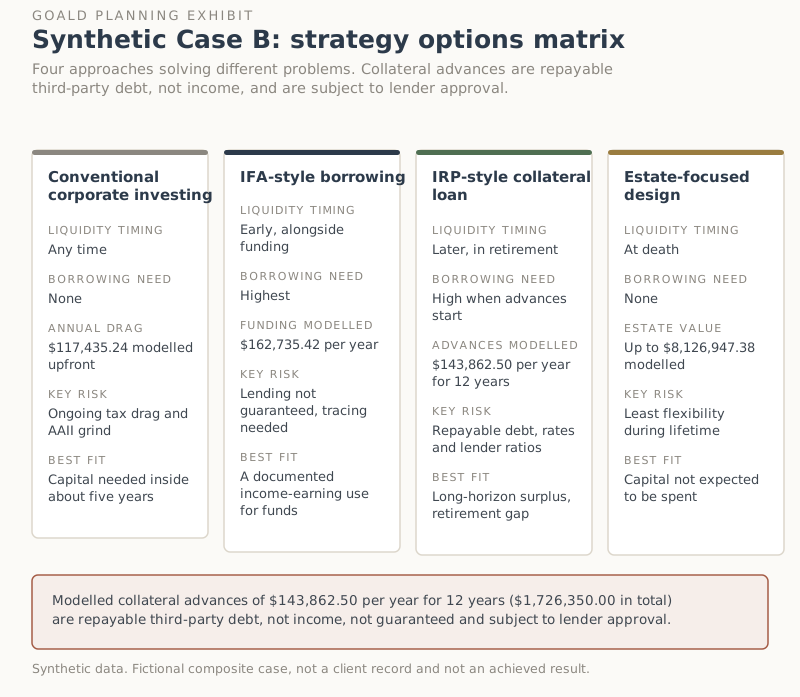
Four approaches are modelled, because they solve different problems:
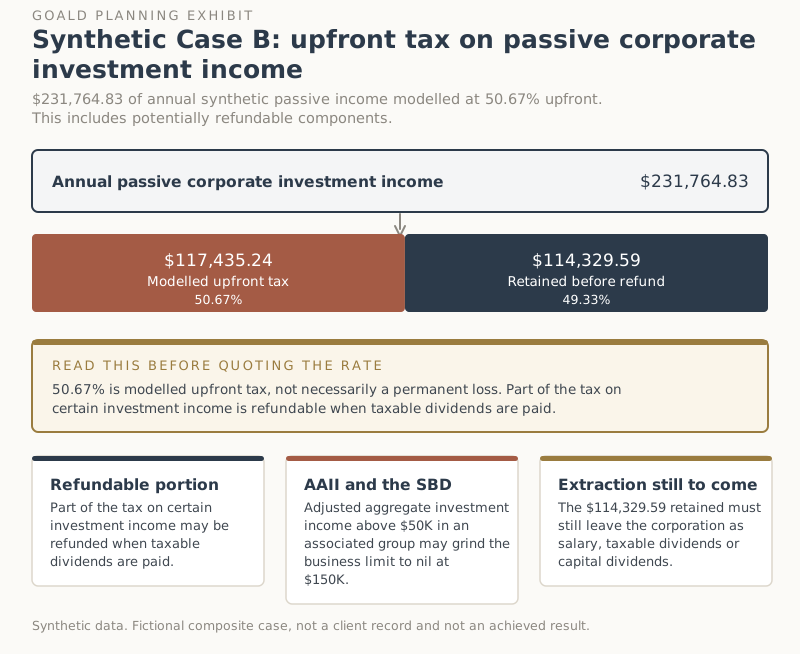
- Conventional corporate investing keeps everything liquid and simple, and carries the annual drag plus the later cost of getting the money out. On $231,764.83 of modelled passive income, the modelled upfront tax at 50.67% is $117,435.24, leaving $114,329.59 before any later refund or distribution.
- An IFA-style borrowing approach funds a permanent policy while a third-party lender may lend against eligible policy cash value if approved, so capital can stay working.
- An IRP-style collateral loan models $143,862.50 per year of collateral-backed advances for 12 years, totalling $1,726,350.00. These are repayable third-party debt, not income, not guaranteed and subject to lender approval.
- An estate-focused design prioritises long-term death benefit, potential capital dividend account credit and estate liquidity, with less emphasis on near-term access.
The output is not a product recommendation. It is a purpose map, a stress-tested blend, and a documented route out of the corporation.
Objectives built into the model.
Corporate surplus was stable and predictable, and the operating business did not need the investment capital. That is a good position and it is still an unanswered planning question, because capital with no assigned purpose tends to default to the least efficient treatment available.
- Tax-efficient treatment of long-term corporate surplus. Reduce the annual drag where it can be done cleanly and without adding fragile complexity.
- Flexibility before retirement. Keep options open while the business is still growing and while property opportunities still appear.
- Potential retirement access. A route to retirement liquidity that does not require liquidating the portfolio in a poor year.
- A stronger estate transfer. Improve what reaches the next generation without surrendering flexibility in the meantime.
The synthetic planning snapshot.
| Planning input | Synthetic figure | Planning note |
|---|---|---|
| Corporate investments, fair market value | $4,187,364.91 | Long-standing surplus with no assigned purpose |
| Corporate investments, adjusted cost base | $3,126,481.73 | Book cost of the corporate portfolio |
| Unrealized gain on corporate investments | $1,060,883.18 | $4,187,364.91 less $3,126,481.73 |
| Gross real estate | $10,946,281.74 | Held corporately and personally |
| Real-estate debt | $3,184,617.29 | Mortgages and secured facilities |
| Net real-estate equity | $7,761,664.45 | $10,946,281.74 less $3,184,617.29 |
| Other net assets | $639,927.76 | Remaining household and corporate assets, net |
| Total modelled net worth | $12,588,957.12 | $4,187,364.91 + $7,761,664.45 + $639,927.76 |
| Annual passive corporate investment income | $231,764.83 | Interest, dividends, rents and realised gains combined for modelling |
| Modelled upfront passive tax rate | 50.67% | Planning assumption; includes potentially refundable components |
| Modelled upfront passive tax | $117,435.24 | $231,764.83 × 50.67% |
| Retained before any later refund or distribution | $114,329.59 | $231,764.83 less $117,435.24 |
| Annual policy funding modelled | $162,735.42 for 10 years | Total $1,627,354.20 |
| Collateral advances modelled | $143,862.50 per year for 12 years | Total $1,726,350.00. Repayable third-party debt subject to lender approval, not income |
| Assumed borrowing rate scenarios | 5%, 6% and 7% | Modelling assumptions used for sensitivity, not offered rates |
Synthetic planning figures generated for education. Not any client's balances.
What Goald reviewed.
- Corporate investments and income character. Interest, foreign income, Canadian dividends, rents and realised gains each behave differently inside a corporation.
- Available cash flow. Sustainable surplus after operating needs, instalments and planned capital expenditure, tested through a weak year.
- Real estate and debt. Gross value, net equity, facility terms, covenants and refinancing timelines.
- Shareholder objectives. Who needs what, when, and how much complexity the family is willing to maintain.
- Retirement timing. When income is expected to be needed, and from which pool.
- Lending capacity. Whether a third-party lender would realistically advance against eligible policy cash value, and on what ratios.
- Insurability. Underwriting outcomes for the intended insured lives before any structure depended on them.
- Policy design and stress tests. Funding pattern, dividend scale sensitivity, lending ratios and longevity.
The situation, and the actual problem.
Synthetic Case B — Corporate Investment and Retirement Planning Household models an incorporated household holding $4,187,364.91 of investments inside the corporate structure, with an adjusted cost base of $3,126,481.73 and an unrealized gain of $1,060,883.18, alongside $10,946,281.74 of gross real estate carrying $3,184,617.29 of debt for $7,761,664.45 of net equity. Corporate surplus is modelled as stable and predictable, and the operating business does not need the investment capital.
That is a good problem, and it is still a problem. The money has accumulated without a job. It is invested, but it has not been assigned to a purpose, and nothing has been modelled about what it would cost to move it from the corporation to the family, in retirement or at death.
Three objectives frame the model:
- Reduce the annual drag on corporate investment income where that can be done cleanly.
- Create a route to retirement liquidity that does not depend on liquidating the portfolio in a bad year.
- Improve what reaches the next generation, without giving up flexibility in the meantime.
All three have to survive a stress test before anything is recommended.
Where the tax drag actually appears.
Corporate investment income is taxed differently from active business income, and the mechanics are frequently described badly. On $231,764.83 of modelled annual passive corporate investment income, the modelled upfront tax at 50.67% is $117,435.24, leaving $114,329.59 retained before any later refund or distribution. The diagram below separates the four places where the cost shows up in the modelling.
Four distinct layers. They are cumulative in effect but separate in mechanism, and only some of them apply to any given dollar.
Passive investment income
Interest, foreign income, rents, Canadian dividends and realised capital gains are each taxed on their own basis inside the corporation. The character of the income matters as much as the return.
Corporate tax and refundable mechanics
A portion of the tax on certain investment income is refundable to the corporation when taxable dividends are paid to shareholders. The headline corporate rate on investment income therefore overstates the permanent cost for those amounts.
Possible small business deduction grind
Where adjusted aggregate investment income in an associated group exceeds the statutory $50,000 threshold, the federal business limit may be reduced, reaching nil at $150,000. That can raise the tax rate on active business income.
Personal extraction
Whatever remains still has to leave the corporation. Salary, taxable dividends, capital dividends where a valid balance and election exist, and shareholder-loan repayments all behave differently.
See the Government of Canada small business deduction page in Sources for the $50,000 to $150,000 adjusted aggregate investment income mechanics and the associated-corporation rules.
The common shorthand is wrong. The modelled 50.67% is an upfront planning rate, not a permanent loss of $117,435.24. Part of the tax on certain investment income is refundable when taxable dividends are paid, income character changes the result, and only one-half of a capital gain is included in income under current law. What is true is that the combination of an annual drag, a possible business-limit reduction and a later extraction cost is expensive enough to be worth planning around.
The small business deduction rules on passive investment income set out the $50,000 to $150,000 range directly, and the modelled group's position against that threshold is one of the first numbers tested.
Giving every dollar a job.
Before comparing any strategy, the capital was split by purpose. This step does more work than any product decision, because it determines how much capital is genuinely long-horizon.
Four buckets with different time horizons, different liquidity requirements and different acceptable levels of complexity.
Emergency and business liquidity
Payroll, tax instalments, covenant headroom and a genuine operating buffer. Stays liquid and stays outside any long-horizon structure.
Near-term investment capital
Property deposits, opportunistic purchases and capital expenditure inside roughly five years. Also stays outside a permanent policy.
Retirement liquidity
Capital intended to support the family's income after the business winds down or is sold. Long horizon, but must eventually be accessible.
Estate capital
Capital not expected to be spent in the owners' lifetime. Longest horizon and the clearest candidate for an estate-focused structure.
Only buckets three and four were treated as candidates for a permanent insurance structure. Sizing the first two buckets honestly is what keeps a long-horizon commitment affordable.
Why we modelled a blend.
Three structures were modelled against buckets three and four. None of them was recommended on its own, and the reasons are as important as the mechanics.
Each is a different trade between near-term capital efficiency, retirement access and estate value.
Immediate financing arrangement (IFA)
A permanent policy is funded and a third-party lender advances against it, allowing capital to be redeployed into the business or investments rather than tied up.
- Interest deductibility only where the borrowed money is used to earn income and the conditions in the CRA interest folio are met.
- A collateral insurance deduction for a portion of the net cost of pure insurance is available only where the statutory requirements are satisfied.
- Lending is not guaranteed and lender terms can change on renewal.
Insured retirement plan (IRP)
The policy is funded now and collateral loan advances are modelled later to support retirement liquidity.
- Advances are bona fide debt: interest accrues and the balance is repayable, normally from the death benefit.
- Advances are limited to eligible cash surrender value under the lender's terms and require lender approval at the time.
- This is not automatic tax-free retirement income and should never be described that way.
Estate-focused policy
An estate bond concept: the policy is designed to maximise death benefit and the capital dividend account credit rather than near-term access.
- Simplest of the three, with no borrowing and no lender risk.
- Lowest flexibility during the owners' lifetime.
- The capital dividend account credit generally reflects proceeds less adjusted cost basis, not the full death benefit.
Illustrated structures only. Any interest deduction depends on use of funds and tracing; see the CRA interest deductibility folio in Sources. Insurance-linked leverage is scrutinised, so documentation, commercial purpose and CPA sign-off matter.
The blend modelled for the family used bucket four as the estate-focused base and bucket three as the layer where future borrowing capacity might matter, precisely so that no single assumption — lending appetite, dividend scale, or the family's own spending — could break the whole plan.
Corporate surplus to death benefit, end to end.
Seven stages. Stages four onward are conditional on lender approval, policy performance and the family's circumstances at the time.
Corporate surplus
Long-horizon capital only, after the liquidity buckets are funded.
Policy asset
Premium funded within the limits the insurer and the Income Tax Act allow. The policy appears on the corporate balance sheet.
Cash value and death benefit
Guaranteed values plus non-guaranteed dividends. Illustrated values are not guarantees.
Collateral borrowing, where approved
A third-party lender may advance against eligible cash surrender value on its own terms. Approval is never automatic.
Redeployed capital
Advances used for business or investment purposes, documented and traced.
Loan and interest tracking
Interest accrues; balances and use of funds are tracked annually with the CPA.
Death benefit, repayment and CDA
The death benefit repays the outstanding balance first. The capital dividend account generally reflects qualifying proceeds less adjusted cost basis, and a valid election is required before any capital dividend is paid.
Illustrated flow only. Lending, deductibility, dividend scale and underwriting outcomes are all conditional and none of them is guaranteed.
The three structures, compared.
| Dimension | IFA | IRP | Estate-focused policy |
|---|---|---|---|
| Access to capital | Early — borrowing begins alongside funding | Later — advances modelled in retirement | Minimal during lifetime |
| Timing | Redeploys capital now | Builds now, draws later | Value realised at death |
| Interest cost | Ongoing from the start | Begins when advances start and compounds if unpaid | None |
| Deductions | Interest where the CRA conditions are met, plus a collateral insurance deduction only where the requirements are satisfied | Generally none where advances fund personal spending | None |
| Retirement use | Indirect — capital stays working in the business | This is its primary purpose | Not designed for it |
| Estate value | Death benefit less any outstanding loan | Death benefit less any outstanding loan | Highest of the three, less policy adjusted cost basis for CDA purposes |
| Lending risk | Highest — ongoing dependence on a lender | High at the point advances are needed | None |
| Best fit | Businesses with a genuine, documented use for redeployed capital | Owners with long-horizon surplus and a real retirement liquidity gap | Owners whose priority is what reaches the next generation |
Illustrated comparison on modelled assumptions. Not a quotation, not a recommendation and not a projection of your result.
What we deliberately kept outside the policy.
The most useful decision in this model was about what not to fund. A permanent policy is a long-duration commitment; the fastest way to damage one is to overfund it from capital that is needed elsewhere.
- The operating buffer. Payroll, instalments and covenant headroom stayed in cash.
- Near-term property and capital expenditure. Anything with a plausible call inside five years was excluded from the funding calculation.
- The family's personal reserve. Personal liquidity was funded before corporate structuring, not after.
- A deliberate margin. The premium was sized below the maximum the balance sheet could theoretically support, so that a slow year does not force a funding decision at the wrong moment.
Interruption is the risk that actually shows up. Sizing conservatively is the only reliable defence.
Current structure versus coordinated plan.
Two states, same balance sheet. The difference is that every dollar has an assigned purpose and a known route out.
Undifferentiated corporate surplus
Investments taxed annually with no assigned purpose, adjusted aggregate investment income tracking near the threshold that can reduce the business limit, no modelled retirement liquidity route, and an unquantified extraction cost at death.
Purpose-mapped capital
Liquidity buckets funded and left liquid, long-horizon capital directed to a blended structure, borrowing capacity treated as an option rather than a plan, and the capital dividend account route documented with the CPA in advance.
Illustrated comparison. Both states depend on facts, province, insurability and law at the relevant time.
What we tested before recommending anything.
Every assumption below was moved in the unfavourable direction, one at a time and then together. The borrowing rates listed are modelling assumptions used to test sensitivity, not offered rates and not a forecast.
- Lower dividend scale. The illustration was re-run below the current scale. Dividends are declared annually at the insurer's discretion and are not guaranteed.
- Borrowing rate scenarios at 5%, 6% and 7%. Assumptions only, used to see when interest overtakes the value of any advance. Where interest is capitalised, the balance compounds.
- Lower lending ratios. Advances tested at materially less than the illustrated percentage of eligible cash surrender value, including a scenario with no lender available at all.
- Longevity. Modelled to advanced age, because a long life with capitalising loan interest is the scenario that stresses a borrowing plan hardest.
- Funding interruption. Premiums paused for a period, to confirm the contract and the plan survive a bad business year.
- Underwriting. Rated or declined outcomes considered before any structure depended on a specific insured being insurable at standard rates.
- Tracing and documentation. Whether the use of borrowed funds could be traced to an income-earning purpose to the standard the CRA interest folio describes, with the CPA's sign-off.
- Ownership and borrower structure. Which entity owns the policy, which entity borrows, and what happens if borrowed money ends up in a shareholder's hands personally, including shareholder-benefit and guarantee-fee questions.
- Repayment at death. Confirmation that the death benefit clears the outstanding balance first, and what remains for the capital dividend account after the policy's adjusted cost basis is taken into account.
A structure that only works on the current dividend scale, at the lowest assumed borrowing rate and with maximum lending available is not a plan. It is a best case. The blend was chosen because it degrades gracefully when those assumptions move.
Related reading: immediate financing arrangements in Canada, the insured retirement plan, the capital dividend account and how to read a whole life illustration, what happens to your corporation when you die and the business owner estate tax calculator, where you can model your own numbers instead of these synthetic ones.
The synthetic policy schedule.
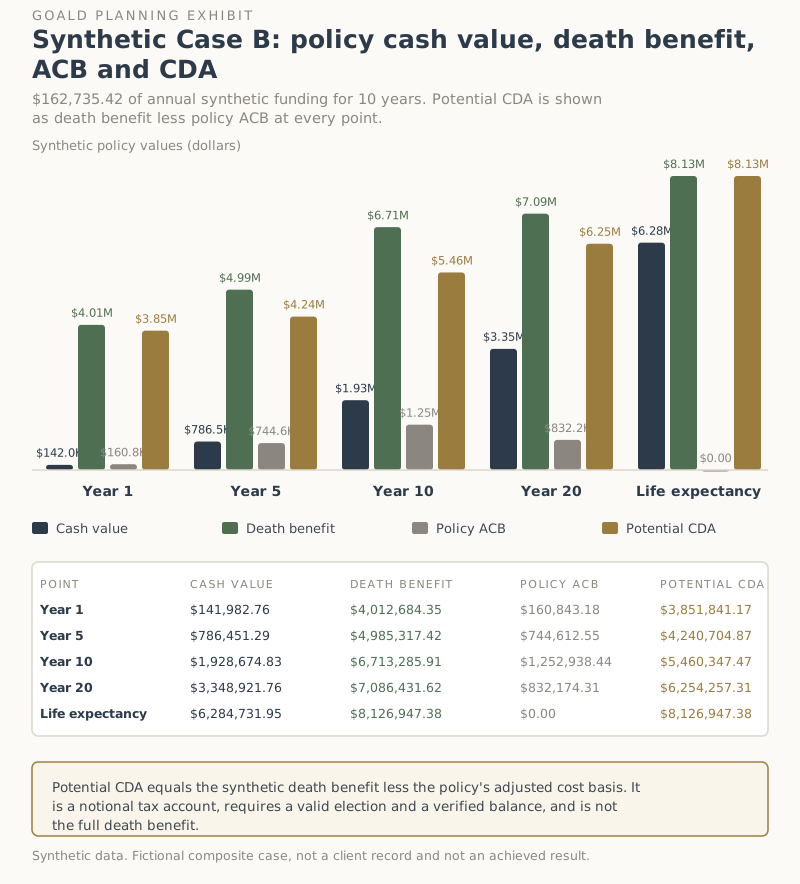
The schedule below is the synthetic policy schedule used in this representative case. It reflects $162,735.42 of annual funding for 10 years, or $1,627,354.20 in total. Illustrated values include non-guaranteed dividends, which are declared annually at the insurer's discretion. These are synthetic model illustrations built from synthetic data, not guaranteed outcomes.
| Policy year | Cash value | Death benefit | Policy ACB | Potential CDA credit |
|---|---|---|---|---|
| Year 1 | $141,982.76 | $4,012,684.35 | $160,843.18 | $3,851,841.17 |
| Year 5 | $786,451.29 | $4,985,317.42 | $744,612.55 | $4,240,704.87 |
| Year 10 | $1,928,674.83 | $6,713,285.91 | $1,252,938.44 | $5,460,347.47 |
| Year 20 | $3,348,921.76 | $7,086,431.62 | $832,174.31 | $6,254,257.31 |
| Life expectancy | $6,284,731.95 | $8,126,947.38 | $0.00 | $8,126,947.38 |
Synthetic illustration based on $162,735.42 of annual funding for 10 years ($1,627,354.20 in total). Values include non-guaranteed dividends and are not guaranteed. The capital dividend account is a notional tax account, generally based on qualifying proceeds less the policy's adjusted cost basis, and a capital dividend requires a valid election.
The IRP layer modelled $143,862.50 per year of collateral-backed advances for 12 years, or $1,726,350.00 in total, against eligible cash surrender value. That is repayable debt, subject to lender approval on the lender's terms at the time, with interest that compounds where it is not paid currently. It is not income, it is not received free of obligation, and it is not guaranteed to be available.
The modelled scenario comparison.
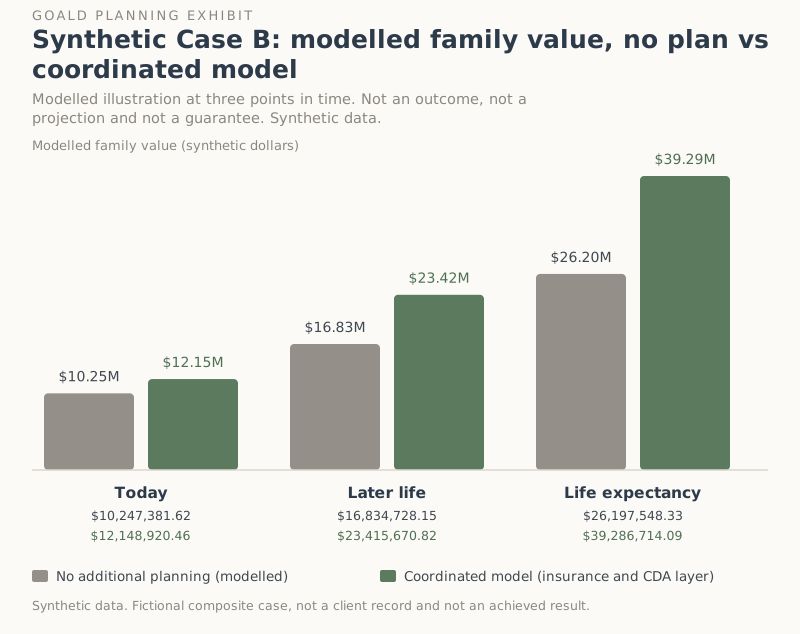
The comparison below sets a modelled no-planning family value against a modelled insurance and capital dividend account layer at three points in time. Every figure is synthetic, and the difference depends on tax, policy performance, lending, timing and estate assumptions.
| Point in time | No-planning family value (modelled) | Modelled insurance and CDA layer | Modelled difference |
|---|---|---|---|
| Today | $10,247,381.62 | $12,148,920.46 | $1,901,538.84 |
| Later life | $16,834,728.15 | $23,415,670.82 | $6,580,942.67 |
| Life expectancy | $26,197,548.33 | $39,286,714.09 | $13,089,165.76 |
Synthetic modelled values. Differences depend on tax, policy, lending, timing and estate assumptions, and are not guaranteed or achieved results.
Trade-offs, risks and professional dependencies.
| Trade-off or risk | Why it matters | How it is managed in the plan |
|---|---|---|
| Long-horizon commitment | Premium funding is a multi-year obligation from corporate surplus | Funded below the maximum capacity, with an interruption scenario modelled |
| Non-guaranteed dividends | Illustrated cash value and death benefit depend on the dividend scale | Illustrations re-run at reduced scales before recommendation |
| Lending is not guaranteed | IFA and IRP layers both depend on a third-party lender approving advances later | A no-lender scenario modelled; estate-focused base carries no borrowing |
| Interest cost and compounding | Where interest is capitalised, the balance grows against the policy | Rate scenarios of 5%, 6% and 7% modelled through to advanced age |
| Interest deductibility | Depends on documented, traceable use of borrowed funds to earn income | CPA confirms tracing and documentation; no deduction assumed without sign-off |
| AAII and the small business deduction | Impact depends on actual investment income and associated group balances | Modelled against the corporation's real numbers with the CPA, not a rule of thumb |
| Insurability | A rated or declined outcome changes cost and structure | Underwriting tested before any structure depends on a specific insured |
| Liquidity concentration | Capital committed to a policy is less available than cash | Only long-horizon buckets funded; operating and near-term capital excluded |
| Legislative change | Tax treatment of policies, elections and passive income can change | Annual review with the CPA, plus review after any material tax change |
Illustrative risk register. Tax, legal, lending, underwriting and policy assumptions must be confirmed with the client's CPA, lawyer and other professionals.
Implementation roadmap and responsibilities.
| Stage | What happens | Who leads |
|---|---|---|
| 1. Purpose map | Split corporate capital into operating liquidity, near-term capital, retirement capital and estate capital | Goald with the owners |
| 2. Tax review | Confirm income character, AAII position, refundable balances and the extraction cost | CPA, with Goald modelling |
| 3. Cash flow test | Confirm sustainable funding through a weak year, with a deliberate margin | Owners and CPA |
| 4. Underwriting | Apply and confirm the actual offer before any structure depends on it | Goald with the insurer |
| 5. Design and stress test | Model the funding pattern, reduced dividend scales, lending ratios and 5%, 6% and 7% rate scenarios | Goald |
| 6. Lending review | Confirm realistic lender appetite, ratios and documentation requirements | Goald with the lender and CPA |
| 7. Documentation | Ownership, beneficiary designation, corporate resolutions and any guarantee or shareholder-benefit issues | Legal counsel and CPA |
| 8. Implementation | Place the policy, fund the first premium and record the structure in the corporate records | Goald and legal counsel |
| 9. Ongoing tracking | Track cash value, loan balances, use of funds and the capital dividend account position annually | CPA, reviewed with Goald |
Illustrative sequence. Actual steps, timing and responsibilities vary with the client's facts and their professional advisers.
The annual review checklist.
- Compare in-force values to the original illustration. Confirm the policy is performing within the modelled range and re-run at a reduced dividend scale.
- Confirm funding capacity. Is the premium still comfortably affordable from surplus after operating needs?
- Review the AAII position. Track adjusted aggregate investment income against the associated group's business limit with the CPA.
- Re-test the purpose map. Have the four capital buckets changed in size or timing?
- Review lending assumptions. Current ratios, current rates and whether a lender would still advance on the modelled terms.
- Track any loan balance and use of funds. Confirm interest treatment and that tracing documentation remains intact.
- Confirm capital dividend account tracking. Verify the CPA's running balance and the policy's adjusted cost basis schedule.
- Check ownership and beneficiary designations. Confirm the owning entity and beneficiary still match the intended route to the family.
- Review retirement timing. Has the expected draw date moved, and does the modelled advance schedule still fit?
- Note legislative change. Record any change affecting passive income, policy taxation or the capital dividend account.
Frequently asked questions.
Is corporate investment income really taxed at 50%?
That shorthand is misleading. Investment income inside a corporation is taxed on its own basis by character, a portion of the tax on certain investment income is refundable to the corporation when taxable dividends are paid, and only one-half of a capital gain is included in income under current law. The real cost is the combination of an annual drag, a possible reduction of the small business deduction where adjusted aggregate investment income exceeds $50,000 in an associated group, and the later cost of extracting the money personally.
Does an insured retirement plan produce tax-free retirement income?
No, and it should not be described that way. What is modelled is a collateral loan: a third-party lender may advance funds against eligible cash surrender value, on its own terms and subject to approval at the time. A bona fide loan advance is generally not income when received, but it is repayable debt, interest accrues, advances are limited by the lender's ratios and the outstanding balance is normally repaid from the death benefit.
Is the interest on an immediate financing arrangement always deductible?
No. Interest deductibility depends on the use of the borrowed money, tracing and the conditions described in the CRA interest deductibility folio. A separate deduction for a portion of the net cost of pure insurance is available only where the statutory requirements for collateral insurance are satisfied. Both are confirmed by your CPA on your facts, and neither is automatic.
How much of the corporate surplus should go into a policy?
Only the portion that is genuinely long-horizon after the operating buffer, near-term investment capital and personal reserve are funded. In this synthetic model the premium was deliberately sized below the maximum the balance sheet could support, because funding interruption is the risk that shows up most often in practice.
What happens if the lender will not advance funds later?
That scenario was modelled explicitly, including a case with no lender available at all. Lending is never guaranteed, ratios can change and credit agreements can be renegotiated on renewal. A plan that only works if a future lender behaves as illustrated is not a plan, which is one reason a blend was modelled rather than a single leveraged structure.
Does the estate receive the full death benefit tax-free?
Not automatically. Where a corporation owns the policy and is the beneficiary, any outstanding loan is repaid first. The corporation's capital dividend account generally reflects qualifying life insurance proceeds less the policy's adjusted cost basis, and a capital dividend can only be paid tax-free to Canadian-resident shareholders where a valid balance exists and the election is properly filed.
Primary sources cited on this page.
Each link points to the official Canada Revenue Agency or Government of Canada publication that supports a technical statement above. Sequencing, commentary and all illustrated figures are Goald & Co's own and are not attributable to the CRA.
- Government of Canada — Passive investment income and the small business deduction rules (adjusted aggregate investment income between $50,000 and $150,000)
- CRA Income Tax Folio S3-F6-C1 — Interest Deductibility (current use, tracing and the conditions for deducting interest)
- CRA Income Tax Folio S3-F2-C1 — Capital Dividends (capital dividend account, life insurance proceeds less adjusted cost basis, and the subsection 83(2) election)
Map My Corporate Tax Exposure.
The first step is understanding the numbers, not committing to a policy. The Tax Exposure Check asks a short set of structural questions and returns the areas most likely to be creating tax and liquidity risk in your structure. Nothing is quoted, no application is started and no figures go to an insurer.
Map My Corporate Tax ExposureDisclaimer. This representative planning case is general educational information published by Goald & Co Financial Inc., an advanced corporate financial and insurance planning firm. It is not tax, legal or accounting advice, and no client relationship is created by reading it. Fictional composite case built from synthetic data. Names, entity structures, values, policy assumptions and outcomes were independently generated for education and do not represent any person or engagement. No figure on this page is an actual client value or an achieved result. The planning workflow reflects the type of coordinated analysis Goald performs with a client's CPA and lawyer; the displayed facts and results are not client records. Goald & Co does not prepare tax returns, valuations or legal documents; implementation runs through your own CPA and legal counsel. Outcomes vary by province, corporate structure, insurability, lender terms and changes in law.