
Participating whole life insurance is more than life insurance. When structured properly, it can provide permanent protection, accumulate cash value, and create a long-term financial asset that can be accessed during your lifetime.
One of its most important features is something many people don't initially realize:
You don't necessarily have to contribute the full illustrated premium every year.
A participating whole life policy can have two distinct funding components:
- Base premium: The required payment that maintains your guaranteed insurance coverage and builds guaranteed cash value.
- Additional Deposit Option (ADO): Flexible, optional contributions that purchase additional paid-up insurance, accelerating cash value accumulation and increasing the death benefit.
Understanding the difference allows you to design a policy around your cash flow, rather than committing to unnecessarily large mandatory premiums.
A Simple Example: $20,000 Per Year Into Whole Life Insurance
Imagine you're a business owner who wants to contribute $20,000 per year into a participating whole life insurance policy.
Rather than making the entire $20,000 mandatory, we structure the policy with two components:
| Annual amount | |
|---|---|
| Base premium (required) | $8,000 |
| ADO (optional) | $12,000 |
| Total available annual funding | $20,000 |
Both components contribute to your participating whole life insurance policy and its cash value.
The difference is how much you're committed to paying.
What if your company's profits change?
| Business year | Base premium | ADO | Total paid |
|---|---|---|---|
| Year 1 — Great year | $8,000 | $12,000 | $20,000 |
| Year 2 — Slower year | $8,000 | $0 | $8,000 |
| Year 3 — Great year | $8,000 | $12,000 | $20,000 |
In year two, you simply skip the optional $12,000 contribution.
Your permanent insurance remains in force because you've continued paying your required $8,000 base premium.
The trade-off? Your cash value and death benefit won't grow as much as they would have if you made the additional contribution.
Think of it this way:
- Base premium: What you commit to paying to maintain your insurance and build guaranteed cash value.
- ADO: Extra money you can contribute when you want to accelerate cash-value accumulation and purchase additional paid-up insurance.
ADO isn't simply a separate investment deposit; it purchases additional permanent insurance with its own cash value. Payments are subject to the insurer's limits and available tax-exempt room.
And eventually, if the policy accumulates sufficient value, you may be able to use premium offset, where the policy helps fund its own required base premiums.
That means your out-of-pocket payments could potentially stop, even though your permanent insurance remains in force.
This is a simplified hypothetical example. Actual funding splits and limits depend on the insurer, policy design, and underwriting. Premium offset is not guaranteed.
A real example: $466,730 annual funding, but only $223,561 required
Below is an anonymized excerpt from an actual Manulife Par illustration dated October 27, 2026.
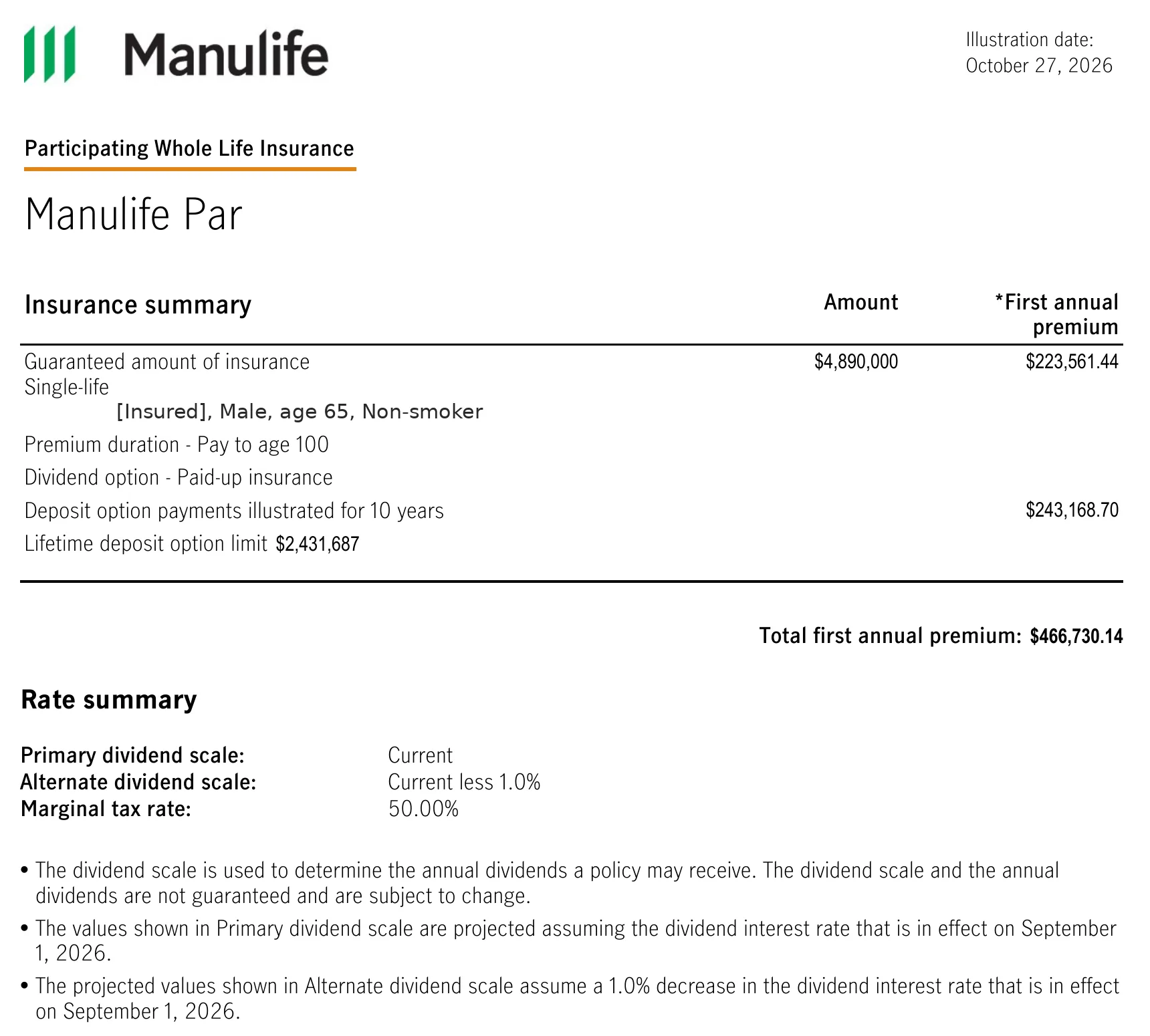
Let's break down what you're looking at.
| Illustration component | Amount |
|---|---|
| Guaranteed initial death benefit | $4,890,000 |
| Required annual base premium | $223,561.44 |
| Optional annual ADO | $243,168.70 |
| Total illustrated annual funding | $466,730.14 |
| ADO contribution period | 10 years |
| Illustrated lifetime ADO limit | $2,431,687 |
At first glance, someone might assume they are committing to paying $466,730 every year.
But the actual contractual base premium is only $223,561.44 annually.
The remaining $243,168.70 is optional ADO funding.
That means the owner has considerably more control over how much capital they contribute.
For example, if the policy allows it, they could contribute the full ADO in a strong business year, reduce it in a slower year, or skip it entirely while maintaining the required base premium.
The ability to increase ADO funding later remains subject to available annual limits, tax-exempt room, and the insurer's administrative and underwriting requirements.
What happens to the money you contribute?
A participating whole life policy isn't a traditional investment account where you directly purchase shares of stocks or bonds.
Instead, the insurer manages a large participating account containing assets such as bonds, mortgages, real estate, and equities.
Premiums support that account, from which the insurer meets its insurance obligations, expenses, and policyholder dividends.
Your policy benefits from its contractual guarantees and can participate in the insurer's experience through annual dividends.
Here's how the two funding components work.
Your base premium
A portion of your base premium supports the cost of providing life insurance, along with other policy obligations and expenses.
The policy also accumulates guaranteed cash value according to a schedule established in the contract.
These guarantees are among the distinguishing features of participating whole life insurance.
Your ADO contributions
ADO payments purchase additional permanent, paid-up insurance.
This additional insurance:
- Adds cash value to your policy.
- Increases your total death benefit.
- Can receive participating dividends.
- Requires no further premium payments for the additional coverage already purchased.
Importantly, ADO isn't a zero-cost investment. It purchases additional life insurance, and the applicable insurance economics are reflected in the resulting policy values.
However, it allows you to put significantly more money into a structure that combines permanent insurance, cash-value accumulation, and favourable long-term tax treatment.
How dividends compound the growth
When an insurer declares a participating dividend, you can generally choose how it is used, subject to your policy options.
In many accumulation-focused policies, dividends are used to purchase even more paid-up insurance.
That additional insurance can then receive future dividends of its own.
Over time, this can increase both the cash value and the death benefit beyond the guaranteed amounts.
Dividends are not guaranteed. However, additional paid-up insurance already purchased generally becomes part of the policy's guaranteed coverage and value, subject to subsequent policy transactions.
For a deeper explanation, see our Participating Whole Life Insurance and How the Par Account Works.
How much ADO can you contribute? Understanding the tax-exempt limit
One of the more interesting features of Canadian participating whole life insurance is that there is a limit to how much additional money you can put into the policy while maintaining its tax-exempt status.
Under Canada's Income Tax Act and Regulations, qualifying permanent life insurance policies can accumulate value without the policyholder paying income tax annually on that internal growth.
This is known as an exempt life insurance policy.
The government doesn't allow unlimited investment accumulation inside life insurance.
Instead, there are rules designed to distinguish a life insurance policy from a primarily investment-oriented arrangement.
How the maximum ADO is calculated
When we're designing and underwriting a participating whole life policy, the insurer can calculate the additional funding permitted within the policy's available exempt-test room and product limits.
The amount can be calculated right down to the penny.
In the illustration above, the annual ADO is $243,168.70, with an illustrated lifetime deposit limit of $2,431,687.
These figures are not arbitrary. They are produced through the insurer's illustration and policy-design system, taking into account applicable limits.
The maximum contribution can depend on the insured's age, policy structure, coverage amount, tax-exempt room, and insurer requirements.
Why does this matter?
Because you may have the opportunity to move substantial capital into an insurance policy where:
- The internal cash value can accumulate without annual policyholder income taxation while the policy remains exempt.
- The policy provides permanent death-benefit protection.
- Cash value may be accessed through policy loans, withdrawals, or third-party collateral financing.
- Death benefits are generally received free of Canadian income tax.
- For eligible corporate-owned policies, a death benefit can create a Capital Dividend Account credit, generally equal to the proceeds received less the policy's adjusted cost basis, subject to applicable adjustments.
Tax-exempt growth does not mean every withdrawal is tax-free. Surrenders, certain withdrawals, and policy loans can trigger taxable policy gains, which is why the method used to access cash value matters.
Why we often illustrate the maximum ADO
Maximum ADO is a funding ceiling, not a funding obligation.
For business owners with substantial corporate assets, we often want to understand how much optional funding capacity can be built into the policy.
That gives the owner more choices.
You might decide to fund at the maximum, contribute substantially less, or adjust your contributions over time.
And if you skip ADO payments, that doesn't necessarily mean the lifetime allowance disappears. For example, the Manulife illustration specifies that its lifetime deposit option limit does not expire simply because payments have been skipped. Annual limits and future underwriting requirements still apply.
The objective is to structure the insurance appropriately from the beginning, while retaining flexibility for the future.
Why this matters for incorporated business owners
The flexibility between base and ADO funding becomes especially valuable when the policy is owned by a corporation.
Business cash flow isn't always consistent.
A company could generate $2 million of profit one year, invest heavily in expansion the next, and then have another exceptionally profitable year.
You may not want a large mandatory insurance premium restricting how that capital is deployed.
With the right participating whole life structure, you can establish a sustainable base-premium obligation while retaining the option to contribute additional corporate surplus through ADO.
This allows you to balance three priorities: permanent insurance protection, long-term cash-value accumulation, and access to capital when opportunities arise.
For example, a business owner may accumulate cash value for several years and later use the policy as collateral for a third-party loan, subject to lender approval and terms.
The underlying policy can remain in force while the borrowed funds are deployed elsewhere.
That's the foundation of strategies such as the Immediate Financing Arrangement (IFA), which can integrate permanent life insurance with corporate liquidity planning.
Frequently asked questions
No. The Additional Deposit Option is optional. The policy's base premium is the contractual commitment, while ADO contributions can generally be adjusted or skipped, subject to insurer rules.
Both base premiums and ADO contribute to a participating insurance structure backed by an insurer-managed investment portfolio.
The ADO specifically purchases additional paid-up insurance with cash value and dividend participation. It is not a separate investment account, and some of its economic value supports the additional insurance coverage purchased.
Potentially, yes. Increases depend on the policy's annual deposit limit, available tax-exempt room, lifetime allowance, administrative rules, and any additional underwriting the insurer requires.
That depends on the policy.
Some policies have a contractual 10-pay design. Others, such as the illustration above, have longer required payment periods but may qualify for premium offset earlier.
Premium offset is based on policy values and future dividends, so it cannot be guaranteed at purchase.
Not simply by choosing to deposit more. The insurer must respect its product limits and the Canadian tax-exempt policy rules. Additional underwriting or changes to the structure may be necessary to accommodate higher contributions.
Cash value inside a qualifying exempt policy generally accumulates without annual policyholder income taxation. However, accessing that value can have tax consequences depending on the method used.
A third-party collateral loan, insurer policy loan, withdrawal, and surrender are different transactions with different tax implications.
Yes. Depending on the insurer, policy design, and lender, options can include collateral borrowing, insurer policy loans, and partial withdrawals.
The most suitable approach depends on your objectives and how you want to preserve future insurance and estate value.
The right whole life policy starts with the right funding structure
When evaluating participating whole life insurance, one of the most important decisions isn't simply how much coverage you purchase.
It's how you structure the funding.
A policy with an unnecessarily large base premium can create a significant long-term commitment.
A thoughtfully designed combination of base premium and flexible ADO can provide substantial permanent protection while allowing you to adjust additional funding as your financial circumstances change.
At GOALD & Co Financial, we help incorporated business owners evaluate participating whole life policies based on corporate cash flow, tax-exempt funding capacity, cash-value objectives, liquidity needs, and estate planning.
We compare the required base premium, maximum ADO, projected cash values, dividend scenarios, and premium offset options so you can understand not only what the policy provides, but how it fits into your broader financial plan.
The objective isn't necessarily to pay the largest premium. It's to design the policy that gives you the right balance of protection, capital accumulation, and flexibility.
Request a customized participating whole life illustration from GOALD & Co Financial.
Your Illustration
See your base premium and maximum ADO
We’ll design a participating whole life illustration around your corporate cash flow: the required base premium, the maximum ADO, projected cash values and the projected premium-offset year.
Two steps. Step 2 asks for a phone number so a licensed Goald advisor can confirm your details before anything is prepared.
Continue with the related references.
Primary references
- Income Tax Regulations, s. 306 — Exempt policies
- Income Tax Act, s. 148 — Life insurance policies (policy gains and dispositions)
- Income Tax Act, s. 89(1) — Capital dividend account definition
- CRA Income Tax Folio S3-F6-C1 — Interest Deductibility
- Financial Consumer Agency of Canada — Life insurance
Educational information only. Insurance guarantees are governed by the issued contract. Additional deposit limits, policy dividends, premium offset and projected values are subject to insurer rules and applicable law. Tax outcomes depend on ownership, transactions and individual circumstances. The $20,000 example is hypothetical. The Manulife Par excerpt is anonymized; projected values use the insurer’s current dividend scale and are not guaranteed.