
The short answer.
“If I put corporate money into a whole life policy, is that money gone?”
This is a real concern we hear from business owners. They understand the insurance benefit. What they want to know is whether they can still access capital if they need it for something else.
Yes, a participating whole life policy can give your corporation access to money while you are alive. You can borrow against the policy, take available cash through dividends or a partial surrender, or cancel the policy for its surrender value. Each option works differently and has its own effect on taxes and coverage.[1]
Think about what happens when you buy stocks.
When you buy stocks, you exchange cash for shares. The money has not simply disappeared. You now own an asset with a value you can track, sell, or potentially borrow against.
That is the point we want people to understand about participating whole life. Your corporation can own an insurance asset with cash value. You are buying insurance coverage, and the policy can also hold value you can use during your lifetime.
There are differences. A policy has insurance costs and expenses, and its cash value may be less than the premiums paid, especially early on. You cannot assume that every premium dollar is available to take back out.
With term insurance, the premiums generally pay for coverage over a set period without building cash value. Participating whole life can provide both permanent coverage and accessible cash value, along with potential dividends. Those dividends are not guaranteed.[3],[4]
Can I check the value like I check my investment accounts?
The idea is familiar. You log in to RBC, TD, Scotiabank, or Wealthsimple to see what you own. With insurance, you can review the policy’s cash value, coverage, and other details through the insurer and your advisor.
Some policies can be viewed through a carrier portal. Online access depends on the insurer and the ownership type, so a corporate policy with Manulife, Canada Life, or Equitable may have different access than a personal policy. Manulife currently excludes corporately owned policies from its personal insurance portal. Statements and your advisor can still help you track the values.[5]
What are the ways to access the money?
| Option | How you get cash | What changes |
|---|---|---|
| Bank loan secured by the policy | A lender advances money using the policy as security. | You owe a loan and interest. The policy stays in place. |
| Loan from the insurer | The insurance company lends under the policy’s terms. | Interest applies. A taxable policy gain may arise. |
| Partial surrender | You give up eligible paid-up additions or part of the coverage for cash. | Policy values and insurance are reduced. Tax may apply. |
| Cash dividends | You receive declared policy dividends rather than reinvesting them. | Future policy growth may be lower. Dividends can have tax consequences. |
| Full surrender | You cancel the policy and receive its available net surrender value. | Coverage ends. A taxable policy gain may arise. |
Why would I borrow instead of taking money out?
For corporate tax planning, a bank loan secured by the policy is often one of the most tax-efficient ways to access capital. The loan advance is generally not taxable income, and giving the bank security over the policy does not itself trigger a taxable policy gain.[2]
The bank lends you its money. You keep the policy in place rather than surrendering cash value to obtain the advance. Your corporation can then use the borrowed funds for the business or other investments.
You still owe the money. Interest, fees, repayment terms, and the amount the lender is willing to advance all matter. The policy and the loan are two separate pieces of the plan.[7]
Cash value lending and premium financing.
There are different ways to structure that bank borrowing. Two you may hear about are cash value lending and premium financing.
| Structure | What it is based on | What to understand |
|---|---|---|
| Cash value lending | An approved percentage of the policy’s cash surrender value. | “Cash surrender value lending” does not mean surrendering the policy. The cash value is used as security. |
| Premium financing | An approved amount linked to the premiums you pay. | A qualifying arrangement may advance up to 100% of premiums. Approval, additional collateral, and guarantees depend on the lender and case. |
An Immediate Financing Arrangement, or IFA, is one example. Your corporation pays the premium, and an approved loan can replace some or all of that capital. It is a loan, rather than a premium refund. Manulife Bank describes using premiums or cash surrender value as the lending basis, with additional collateral where required.[8]
What could I access in the first year?
Here is one example from a Manulife Par joint last-to-die illustration. This type of policy generally pays its death benefit after the second insured person dies.[3]
| Policy year 1 | Amount |
|---|---|
| Annual premium | $78,794 |
| Guaranteed cash value | $69,678 |
| Illustrated total cash value at the current dividend scale | $72,192 |
| Guaranteed death benefit | $3,000,000 |
This is the part that often changes how a business owner sees the policy. The premium is $78,794, and the illustration already shows meaningful cash value in year one.
If a lender approves borrowing against 100% of the eligible cash value shown, the advance could be approximately $72,192 before fees, interest reserves, or other adjustments.
If the borrower and policy qualify for financing equal to 100% of the annual premium, the gross advance could instead be $78,794. The lender may require additional collateral or guarantees, and it must accept this premium amount and case.[8],[9]
Those are two alternative structures. They are not two separate amounts you can add together. The borrowing also creates debt, which needs to be included when looking at the corporation’s overall position.
Example only: these are not your numbers. The $72,192 includes non-guaranteed illustrated values; the guaranteed year-one cash value shown is $69,678. These are policy-year-one figures, and the insurer and lender must confirm when funds can actually be accessed. A custom illustration and a separate lending review are needed for your situation.
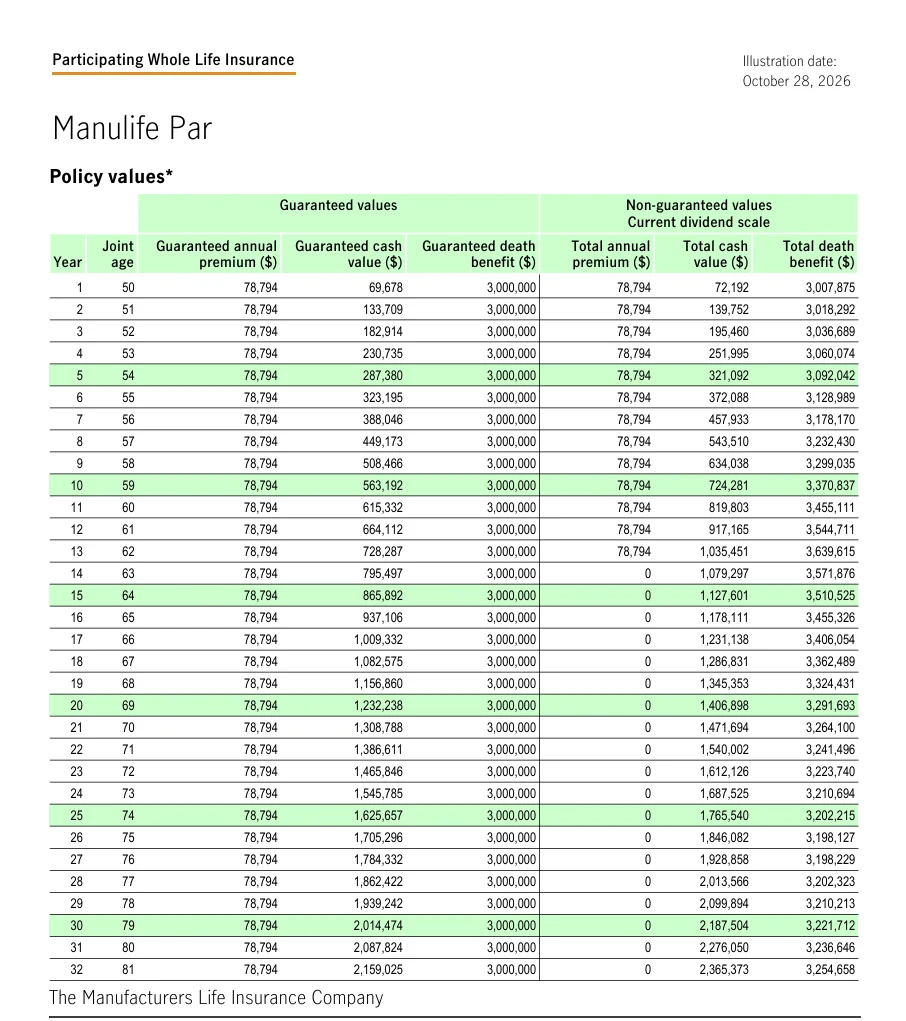
Looking further out, the same illustration shows premiums stopping after year 13 on the current dividend scale while the cash value keeps growing. The guaranteed columns assume premiums continue.
- Illustrated cash value (current dividend scale)
- Premiums paid, illustrated (stop after yr 13)
- Guaranteed cash value
- Premiums paid, guaranteed (never stop)
Do I have to borrow against the policy?
No. You can own participating whole life insurance without using any leverage. Borrowing is one option. If you prefer to avoid debt, ask what cash you can access directly and what that would do to the policy.
Take dividends in cash
If the contract allows it, you may choose to receive declared dividends in cash. That means those dividends are not being used to buy more insurance or support another dividend option. It can reduce future illustrated values, and tax may apply. A policy dividend is separate from a dividend your corporation pays to you.[4],[10]
Take cash by surrendering part of the policy
You may be able to surrender eligible paid-up additions or reduce coverage to release cash. Paid-up additions are extra insurance often purchased with dividends. Giving them up reduces cash value and the death benefit; the loss of coverage can be greater than the cash received. A taxable policy gain may also arise.[6]
This is a permanent change, rather than a loan you can simply repay to restore the same benefits. Get an updated illustration showing what remains after the transaction.
Cancel the policy
A full surrender ends the coverage and pays the available net surrender proceeds after amounts owed and any applicable deductions. Tax may apply. Before cancelling, ask the insurer for the net payment and taxable gain, so you know what the corporation would actually receive.[5],[10]
Is a loan from the insurer the same as a bank loan?
No. An insurer policy loan is made under the insurance contract. A bank collateral loan is a separate lending agreement.
In Canada, a cash policy loan can create a taxable policy gain if its tax proceeds exceed the policy’s remaining adjusted cost basis, or ACB. That is different from simply borrowing from a bank against the policy.[10]
Insurer policy loans also charge interest. Unpaid debt affects the benefits available, and too much debt can cause the policy to end. Any required corporate signatures, lender consent, or beneficiary consent must be obtained.[11]
If my corporation borrows, can I spend that money personally?
That is a separate question. If the corporation owns the policy and borrows the money, the proceeds belong to the corporation. Paying them to you as salary, dividends, or a shareholder loan has its own tax treatment. A loan that is not taxable income to the company does not automatically become tax-free personal spending money.[2]
Borrowing personally against a corporate policy also needs careful planning, because corporate security for a shareholder’s personal loan can create shareholder-benefit issues.[12]
What should I check before choosing an option?
Start with how much cash you need, what it will be used for, and how long you need it. Then compare the after-cost result of borrowing with the result of taking cash directly.
For borrowing, check interest, fees, repayment terms, and what happens if rates rise or the policy performs below the current dividend illustration. Confirm whether the lender can demand repayment and what you would do if more collateral or cash payments were required.[2],[9]
Interest deductibility depends on how the borrowed money is used and the other tax requirements. The policy being used as collateral does not make the interest automatically deductible.[13]
For a withdrawal, do not assume you can take all your premiums back tax-free. ACB is a changing tax calculation, not simply premiums paid. Partial surrenders generally use an allocated portion of ACB, and a taxable policy gain is income rather than a capital gain.[6],[10]
Questions business owners ask us.
It may be possible with a suitable policy and lending arrangement. Check the actual policy values, the date you need the funds, and the lender’s approval. The illustration alone does not promise immediate access.
A collateral loan does not itself withdraw cash value. The policy stays in place under its own terms. Dividends remain non-guaranteed, required premiums must still be funded, and borrowing costs affect your net result.
Because you are borrowing the lender’s money while keeping the policy. Taking cash directly avoids loan interest but can reduce the policy and create tax. The right comparison is what each choice leaves you with after costs.
If debt remains when the death benefit is payable, the lender’s claim is settled under the lending and assignment terms, reducing the insurance cash left for other purposes. With joint last-to-die coverage, that benefit generally pays after the second death.
What would this look like for my corporation?
That is the comparison worth making. We can show you the premium, the guaranteed and non-guaranteed values, the insurance benefit, and the access options for your own situation. Then we can review the structure with your accountant.
Custom Illustration
Show me my options
Request a custom illustration or a review of a policy you already own. We’ll show the premium, guaranteed and non-guaranteed values, the insurance benefit, and the access options for your situation.
Two steps. Step 2 asks for a phone number so a licensed Goald advisor can call to confirm your details before anything is prepared.
Continue with the related references.
Sources and disclosure.
Primary sources
- Canada Life — Participating life insurance 101
- Canada Life — Accessing cash value from a corporate-owned life insurance policy using collateral loans
- Manulife — Sample insurance contracts, including joint last-to-die and term coverage
- Equitable — Your guide to Equimax
- Manulife — Individual insurance FAQs
- Canada Life — Cash withdrawals from corporate-owned life insurance
- Equitable — Life policy collateral loans
- Manulife Bank — Specialized lending
- Equitable Bank — Immediate Financing Arrangement guide for advisors
- Income Tax Act — Section 148
- Manulife — Application for policy loan or withdrawal, NN0522E, February 2025
- Canada Revenue Agency — Shareholder benefits
- Canada Revenue Agency — Income Tax Folio S3-F6-C1, Interest Deductibility
About the example
The Manulife Par example is a joint last-to-die illustration supplied by GOALD, dated October 28, 2026. Values in the non-guaranteed columns use the current dividend scale. Goald & Co Financial Inc. is an independent insurance brokerage and is not Manulife.
Disclaimer. This guide provides general Canadian insurance and tax information. Your contract, lender approval, and circumstances determine what is available. Illustrations are not guarantees. Review a proposed transaction with your licensed insurance advisor and your tax and legal advisors.
Footnote
This publication is protected by copyright. Goald & Co Financial Inc. is not Manulife. This is educational information, not tax, legal or lending advice. Questions: info@goald.ca.